“My Disability was Treated Like a Big Secret”: Disabled Perspectives on Anti-Ableist Discussion in Elementary and Secondary Classrooms in the United States
« Mon handicap était tenu dans le secret » : Perspectives des personnes handicapées sur les discussions anticapacitistes dans les classes du primaire et du secondaire aux États-Unis
Dr. Christa S. Bialka
Associate Professor
Villanova University
christa [dot] bialka [at] villanova [dot] edu
Dr. Nicole Hansen
Associate Professor
Seton Hall University
hansenni [at] shu [dot] edu
Dr. Irene P. Kan
Professor
Villanova University
irene [dot] kan [at] villanova [dot] edu
Stella Mihas
Undergraduate Student
Villanova University
smihas [at] villanova [dot] edu
Jenevieve Erickson, M.A.
Mathematics Educator
Weehawken High School
jerickso [at] weehawken [dot] k12 [dot] nj [dot] us
Abstract
While scholars have cited the importance of disrupting ableism in schools, there is a need for research that examines how students receive information about disability, as well as the lens that teachers apply when talking about disability in the classroom. Anti-ableist discussion has the potential to challenge disability stigma and increase awareness of disability identity and culture. Little is known, however, about whether students in kindergarten through grade 12 (K-12) in the United States engage in anti-ableist discussion. Researchers also stress the importance of including the insights of disabled people when considering anti-ableist practices, as their perspectives are frequently underrepresented in critical research. The present exploratory, survey-based study aimed to better understand how disabled individuals (n=88) experienced anti-ableist discussion during their K-12 experiences in the US and learn from insights they have for K-12 teachers. Data indicated that over 30% of participants did not recall engaging in any type of disability discussion during their schooling. When participants recalled encountering conversations about disability, it was typically not presented through an anti-ableist lens. Through this research, we share concrete strategies that can be used to increase anti-ableist discussion in schools.
Résumé
Alors que plusieurs chercheuses et chercheurs soulignent l’importance de remettre en question le capacitisme en milieu scolaire, il reste essentiel d’examiner la manière dont les élèves reçoivent l’information sur le handicap et les cadres d’interprétation que les enseignantes et enseignants mobilisent pour en parler en classe. Les discussions anticapacitistes peuvent remettre en question la stigmatisation du handicap et approfondir la compréhension de l’identité et de la culture handicapées, mais on sait peu si elles sont réellement présentes dans les écoles de la maternelle à la 12e année aux États Unis. Les chercheuses et chercheurs rappellent aussi la nécessité d’intégrer les perspectives des personnes handicapées, trop souvent absentes des recherches critiques.
Cette étude exploratoire, fondée sur un sondage, visait à saisir l’expérience de personnes handicapées (n = 88) quant aux discussions anticapacitistes durant leur parcours scolaire de la maternelle au secondaire aux États Unis et à recueillir les enseignements qu’elles souhaitent transmettre aux enseignantes et enseignants. Plus de 30 % des participantes et participants ne se souvenaient d’aucune discussion sur le handicap, et les conversations rapportées n’étaient généralement pas abordées dans une perspective anticapacitiste. À partir de ces constats, nous proposons des stratégies concrètes pour renforcer la présence de discussions anticapacitistes dans les écoles.
Keywords: Disability, Ableism, Teacher Education, Elementary Education, Secondary Education; Curriculum
Mots-clés : Handicap, capacitisme, formation des enseignantes et enseignants, éducation primaire, éducation secondaire, programme d’études
In 2019, a Washington Post article detailed the issues that disabled students in the United States routinely encounter. Although some of the barriers related to physical inclusion, the biggest obstacle that disabled students spoke of was exclusive societal perceptions of disability. As Anna Landre, a sophomore student featured in the article, noted: “In praising achievement as ‘overcoming’ disability, we are only teaching that disability is incompatible with success. Only when we learn to view disability as a normal part of human diversity will these harmful practices and inequalities cease” (Vargas, 2019). One inroad to addressing negative, or ableist, perceptions of disability is by discussing disability with school-aged children early on, before belief systems become entrenched (Derman-Sparks & Edwards, 2010; Lalvani & Bacon, 2019; Sapon-Shevin, 2017).
Ableism is “a system of discrimination and exclusion that oppresses people who have…disabilities” (Rauscher & McClintock, 1996, p. 198). Disability Studies in Education (DSE) is a field of study that recognizes ableism as a systemic issue and challenges deficit-oriented views of disability as related to education (Connor et al., 2015; Cosier & Pearson, 2016). DSE aims to disrupt the narrative that disability is an undesirable condition that requires overcoming, curing, or fixing (Baglieri & Lalvani, 2020). Like other “isms,” ableism can function interpersonally: when people personally disrespect or mistreat disabled individuals; institutionally: when legal, educational, economic, political, and social institutions uphold ableism; and internally: when disabled people start to believe the stereotypes, prejudice, and negative messages society sends about disability/being disabled.
Theoretically, ableism most closely aligns with the medical model of disability (Valle & Connor, 2011), which assumes that disability is a fixed condition requiring intervention, and disabled people must adapt to society. Much of current teacher training in the United States is aligned with the medical model, as it focuses on how to comply with legal aspects of special education (i.e., service delivery and IDEA) (Hansen, Kan, et al., 2024). The focus, therefore, is on how to “fix” or “correct” attitudes and behaviors deemed non-normative (Ashby, 2012; Valle & Connor, 2011). As a result, teachers may either draw on a deficit-based lens when discussing disability with their students or avoid disability-related discussion altogether. Furthermore, the theoretical model that a teacher uses when discussing disability can frame how they talk about disability with their students (Bialka et al., 2024). While teachers who invoke the medical model sometimes bring up disability in the classroom, they often engage in what we term general disability discussion. For example, the teacher may rely on clinical definitions and labels to discuss disability with their class or focus solely on accommodations when talking about it in a one-on-one conversation with a student.
While the medical model is premised on changing the disabled person, the social model of disability shifts the focus from the person to the environment. DSE ascribes to the social model, highlighting the ways disabled people are excluded from society (Oliver & Barnes, 2010). Teachers who draw on the social model may engage students in anti-ableist discussion, which is used to develop students’ awareness of the social, economic, physical, and academic barriers disabled people encounter, as well as to recognize how ableism can operate institutionally, interpersonally, and internally (Hansen, Bialka, et al., 2024). Baglieri and Shapiro (2017) organize anti-ableist discussion into four tenets (Table 1).
Table 1
| Tenet | Definition |
|---|---|
| Tenet 1 | Teachers and students reflect on their own or others’ attitudes and actions related to disability. |
| Tenet 2 | Teachers and students recognize that human variation is normal. |
| Tenet 3 | Teachers and students develop a deeper understanding of disability rights and awareness. |
| Tenet 4 | Teachers and students question stereotypes related to disability. |
Although general disability discussion and anti-ableist disability discussion have their place in the classroom, only anti-ableist disability discussion works to challenge ableist beliefs about disability (Hansen, Bialka, et al., 2024).
Many teachers are reluctant to engage students in conversations related to disability (Sapon-Shevin, 2017), especially those that are anti-ableist. However, research (Baglieri & Lalvani, 2020; Darrow, 2013; Hansen, Kan, et al., 2024) has indicated that a leading factor that inhibits teachers’ use of disability discussion is the fear of offending disabled students. But by not talking about disability, children come to believe the message that it is not appropriate or polite to talk about disabilities (Lalvani & Bacon, 2019; Sapon-Shevin, 2017). A lack of anti-ableist discussion in K-12 classrooms can inadvertently reinforce disability stigma and allow any negative attitudes toward disability to go unquestioned (Sapon-Shevin, 2017).
Negative attitudes toward disability can also limit social opportunities for disabled students (Chae et al., 2019; Freer, 2023) and increase their feelings of internalized ableism (i.e., internalizing the stereotypes, prejudice, and negative messages often associated with disability; Baglieri & Shapiro, 2017; Freer, 2023). Mueller’s (2019) work with disabled high school students highlights the importance of addressing ableism. In her qualitative investigation of four disabled students’ understandings of their disability labels, each students’ conception of their disability label revealed “a reproduction of stigmatized, negative ideas and narratives about disabilities” (p. 277). In other words, though the four students’ stories differed, each contained examples of internalized ableism.
Although scholarship related to the importance of integrating anti-ableist discussion in K-12 schools has increased in recent years (Bacon & Lalvani, 2019; Bialka et al., 2024; Hansen, Kan, et al., 2024; C. Mueller, 2019), this body of research is still nascent. Additionally, scholars (Erevelles & Minear, 2010; Mueller, 2019) have stressed the importance of including the insights of disabled people when considering anti-ableist practices, as disabled people are frequently underrepresented as knowledge contributors in critical research. In response, the present study aimed to forefront the experiences and related expertise of disabled people in the United States through investigation of the following questions:
- Do disabled individuals recall having conversations about disabilities during their kindergarten through 12th grade education? If so, to what extent did participants recall that those conversations incorporated anti-ableist discussion?
- What insights and suggestions do disabled individuals have for teachers who would like to engage in anti-ableist discussion in K-12th grade classrooms?
Methods
The purpose of this exploratory, survey-based study is twofold: (1) to better understand how disabled individuals experienced disability-related discussion during their K-12 experiences in the United States, and (2) to learn from insights they have for teachers who would like to discuss disability in their K-12 classrooms.
Participants
After receiving approval from the university Institutional Review Board, we (the research team) recruited participants for the study. Selection criteria included individuals who (1) were living in the United States and self-identified as disabled, (2) were aged 18 or over, and (3) have earned a high school degree or graduated from a GED program. The survey was disseminated through an office of disability services at one private, northeastern university; professional contacts (LinkedIn) and channels (the Society for Disability Studies listserv); and two disability-led advocacy organizations located in the northeastern United States. Recruitment yielded 88 survey respondents. Table 2 provides additional participant demographic information. Participants were also given the option of sharing any additional demographics that informed their experience as a disabled person.
Table 2
| Demographic Category and Description | Percentage of Respondents (count) |
|---|---|
| Age Group | |
| 18-23 | 38.6% (n = 34) |
| 24-29 | 28.4% (n = 25) |
| 30-39 | 18.2% (n = 16) |
| 40-49 | 9.1% (n = 8) |
| 50-59 | 4.5% (n = 4) |
| 60 and older | 0.0% (n = 0) |
| Prefer not to answer | 1.1% (n = 1) |
| Race & Ethnicity | |
| African American or Black | 3.4% (n = 3) |
| Asian | 6.8% (n = 6) |
| Hispanic or Latino Origin | 3.4% (n = 3) |
| Multi-racial | 14.8% (n = 13) |
| White | 68.2% (n = 60) |
| Prefer not to answer | 3.4% (n = 3) |
| Self-identified Disability | |
| Hearing-related | 10.2% (n = 9) |
| Immunocompromised | 12.5% (n = 11) |
| Learning-related | 34.1% (n = 30) |
| Mental health-related | 42.0% (n = 37) |
| Mobility-related | 26.1% (n = 23) |
| Neurodivergent | 35.2% (n = 31) |
| Sensory-related* | 23.9% (n = 21) |
| Vision-related | 15.9% (n = 14) |
| Other (not listed)** | 17.0% (n = 15) |
| Prefer not to share | 1.1% (n = 1) |
| Total Number of Self-identified Disabilities | |
| One | 37.5% (n = 33) |
| Two | 33.0% (n = 29) |
| Three | 17.0% (n = 15) |
| Four or More | 12.5% (n = 11) |
Research Team
Our research team was composed of five individuals: three university faculty members and two university students. One student member of the team was in a graduate program working toward a Master’s degree in School Counseling, the second student member is an undergraduate majoring in Psychology. All members identify as women. Additional demographic characteristics include members’ race (white; n=4; Asian-American; n=1) and disability identity (non-disabled; n=4; disabled; n=1). Additionally, two of the university faculty members are former K-12 special education teachers.
Data Sources
This study involved a 14-question Qualtrics survey (see Appendix A) that aligned with the two research questions. We used closed-ended quantitative measures to better understand the grade levels where participants may (or may not) have discussed disability, as well as the nature of any disability discussion (RQ1). Although survey Q5 (In your opinion, what qualifies as discussing disability positively?) did not explicitly use the term “anti-ableist,” the three options provided for this question were aligned with the goals of anti-ableist discussion: (1) teacher(s) avoid disability-related stereotypes; (2) teacher(s) use language that frames disability positively; (3) teacher(s) raise awareness about barriers that can limit accessibility/inclusion (Baglieri & Shapiro, 2017).
We used open-ended questioning to gain insight into the ideas and suggestions that disabled individuals have for teachers who are looking to discuss disability in their classrooms (RQ2). Open-ended response scenarios were created in response to previous research (Bialka et al., 2024) that asked teachers about barriers related to disability-related discussion. The survey was vetted by two disability-led organizations prior to implementation. They provided feedback related to language and question options and were compensated for their time and expertise.
Data Analysis
Four members of the research team were responsible for data analysis. Two team members analyzed the close-ended quantitative data using SPSS (Version 26) to generate descriptive statistics. Two other members engaged in initial and axial coding of open-ended data (Miles et al., 2014; Srivastava & Hopwood, 2009) using Atlas.ti. The first analytical step was to gain an overview of the extent to which participants recalled discussing disability, and among those who did, we further probed the extent to which they recalled that the discussions were anti-ableist (RQ1).
When analyzing open-ended data (RQ2), we started by familiarizing ourselves with the responses for the two open-ended scenarios, which included reading all responses and taking analytic memos. In the first scenario (Q10), participants were asked: “A teacher tells you they* are hesitant to discuss disability with their classroom because they fear they will say something offensive. How would you respond? (*gender inclusive pronoun)” (n = 61). In the second scenario (Q11), participants were asked: “A teacher tells you that they would like to talk about disability in their classroom. What advice or suggestions would you offer?” (n = 66; participants were given the option to skip these questions, which is reflected in the lower n values).
Next, we reviewed the data using four a priori codes aligned with the tenets of anti-ableism (see Table 1; Baglieri & Shapiro 2017). We used this codebook to independently code the first twenty responses for Q10, then compared codes and memos and calculated inter-coder agreement (94%). After discussing discrepancies in codes, we re-coded the 20 responses for Q10 and added the remaining 41 responses for analysis. This yielded an inter-rater reliability percentage of 98.2%. We repeated the procedure for all Q11 responses, which yielded an inter-rater reliability percentage of 92.9%. For reporting purposes, we consolidated data that we coded for Tenet 1 and Tenet 4 into one theme.
Results
RQ 1: Do disabled individuals recall having conversations about disabilities during their kindergarten through 12th grade education? If so, to what extent were these conversations positive?
Survey Question 1: I can recall classroom discussions about disability.
When participants were asked if they could recall classroom discussion about disability across different levels of schooling (i.e., elementary [Grades K-5], middle [Grades 6-8], and/or high school [Grades 9-12]) or if they had never recalled discussing disability, the most common grade-level context in which disability discussion arose was in high school (43.4%), followed by middle school (25.3%), and elementary school (22.9%); 32.5% of participants recalled never discussing disability at any grade level, and 7.2% of respondents did not recall if/when disability discussions might have occurred in the classrooms (1.1% of participants did not respond to this item).
Survey Questions 2, 3, and 4: During [Elementary/Middle/High School], how frequently did your teachers discuss disability positively?
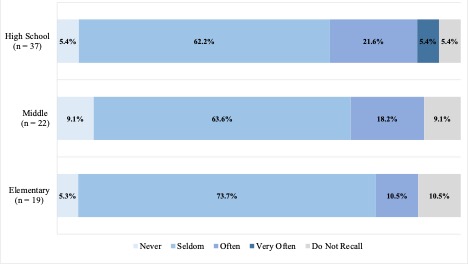
Next, participants were asked to estimate the frequency of positive conversations regarding disability at each schooling level that they recalled such conversations. Participants were also given the option, “I do not recall.” The participants that selected the initial “I cannot recall” (n=8) or “Never” (n=28) options were not shown the questions pertaining to the frequency of positive discussions. As Figure 1 shows, across all levels of schooling, the most reported response was “seldom.” Comparatively, fewer participants selected “often” regarding the frequency of positive disability-related discussion. Thus, these data indicate that while disability discussion may have occurred, not all discussions were perceived as positive by the respondents.
Survey Question 5: In your opinion, what qualifies as discussing disability positively?
To better understand what constituted positive discussions, respondents were offered three closed-ended options (raise awareness; use positive language; avoid stereotype) and one open-ended option where they could offer their own response. Participants were also allowed to choose more than one response. Most participants selected raise awareness (85%), followed by use positive language, (70%), and avoid stereotype (62%). Sixteen participants (18.2%) also offered open-ended responses. Overarching themes from these responses included: Discussing disability culture, pride, history, intersectionality, and identity; Addressing ableism; Focusing on language use (i.e., identity first language, not using outdated terminology); and Situating the disabled person as expert (learning from disabled people and reading texts by disabled authors).
RQ2: What insights and suggestions do disabled individuals have for teachers who would like to engage in disability discussion in K-12th grade classrooms?
Develop a Deeper Understanding of Disability Rights and Awareness (Tenet 3)
When responding to the two open-ended scenarios, participants noted the importance of teachers educating themselves about disability history, culture, and language. Participants felt that professional development offered one way for teachers to learn “how to facilitate these discussions [and] the evolving nature of language and how it’s used to reinforce stereotypes but sometimes disrupt them.” Participants also said that teachers should research disabled people’s experiences, especially those of disabled activists. In one representative quotation, a participant noted: “If [the teacher is] worried about saying something offensive, doing research about ways to talk about the subject would be the best start.” Participants noted that self-education has the potential to make teachers more comfortable engaging in discussion and to provide them with an opportunity to dispel any implicit, negative perceptions of disability. Participants also provided a list of texts to guide teacher reflection and awareness (Appendix B).
Reflect On Their Own Or Others’ Attitudes And Actions Related To Disability (Tenet 1) and Question Stereotypes Related To Disability (Tenet 4)
Participants stressed that teachers should actively engage with disability through internal work, such engaging in self-reflection, and external engagement, like refraining from silence, implementing inclusive classroom practices, and seeking out members of the disability community. Several participants offered that the teacher should start with themselves. They suggested that if teachers are fearful of discussion, “I would ask them what they’re afraid of and who they’re afraid of offending. Usually, the individual is more uncomfortable themselves than any disabled kids who know how it goes from their own experiences.” Participants continually expressed that “messing up,” reflecting, and recalibrating is better than a teacher entirely avoiding disability discussion. As one participant noted, “They will mess up sometimes, [but] they’ll mess up more by completely avoiding the topic.”
To this end, participants stressed that teachers should not stay silent. Participants shared that, “Talking about disability is less offensive than avoiding it. By avoiding the topic, they are treating it like it’s bad or it’s a problem,” and:
I would encourage [teachers] to recognize that that fear and lack of open dialogue is what perpetuates the fear and separation and stigma. I would share resources for them to get familiar and comfortable and encourage them to be ok not being comfortable so they don't perpetuate similar discomfort in their students.
Another participant shared that students are naturally curious about disability, and it is better to address misconceptions rather than stay silent and let children internalize that disability is “bad” or “wrong”:
It is inevitable for us in society to run into those with disability, and some of us notice family members or friends with disabilities at a young age. Just keeping people in the dark about it sends the wrong message, teaches people to be afraid of disability, can be taken as a sign that the teacher lacks sufficient willpower or skill, and only makes people with disabilities feel more isolated, othered, and ignored.
Similarly, a participant shared:
We see so many euphemisms that try to “soften” what is assumed to be NEGATIVE which for many people with disabilities is a positive experience/identity. We have to model as teachers how to have difficult dialogues, the importance of being called in when mistakes are made which are human and the variability in how disabled people prefer or understand the experiences of disability. #saytheword
All participants felt strongly that talking about disability—even if it meant “messing up”—was more beneficial than either invoking euphemistic language, such as “differently-abled” instead of saying “disabled,” or avoiding disability-based discussion altogether.
While participants suggested that teachers work to enhance their understanding of disability, they also noted the importance of seeking input from disabled people, either as a means of forefronting disabled perspectives or helping facilitate discussion with students. In one representative quotation, a participant said, “I would encourage them to include disabled people in the discussion and to consult with disabled people to structure the conversations or key messages.” Participants also stated the importance of actively connecting with members of the disability community: “I would recommend that they bring in a guest speaker with a disability to discuss the topic. Perhaps this could even help the teacher for the future in feeling like they can discuss it on their own.” Several participants noted, however, that while some disabled people might readily participate in discussion, it is not the responsibility of all disabled people to educate non-disabled people about disability identity. As one participant shared, “[Teachers should] never single someone they know to have a disability out,” especially a student in their classroom.
Recognize that Human Variation is Normal (Tenet 2)
Additionally, participants highlighted the importance of cultivating inclusive classroom spaces. Several noted that making students aware of the social model of disability could not only make them aware of barriers that disabled people encounter, but it could also highlight disability as a minoritized social identity. As one participant stated: “It is important for students to come away with the knowledge that disability is only a bad thing because society’s systems are designed in a way that is not inclusive, not because disabilities themselves are limiting.” Another suggested:
[Teachers could] frame [disability] discussion in terms of strengths and resilience of disabled people, as well as social and economic barriers to disabled peoples’ participation in society—it is possible to really distill the social model of disability for all ages!
Participants also said that classroom culture could help or hinder students’ understanding of their own disability identity. Two participants said that they wished that their teachers had tried to use discussion to create a classroom where they felt seen and supported rather than othered. As one participant said:
The one thing I would have wanted my teachers to discuss was that their classroom was a safe space and that if I felt overwhelmed at any time I could step out or talk to them about it. Instead, I often felt trapped.
Another participant shared that while they did not see their disability as a “big secret,” teachers viewed it that way, and they perceived they were made to feel stupid because of their diagnosis:
As a person with a learning disability I was treated like it was a big secret, but the teachers always made a big deal of when I left the classroom for tutoring and things like that. I don't know the world any differently. This is how my brain has always worked…I had to go through a lot to get to where I am today because a lot of people either implied or told me that I was not smart enough.
Participants also noted specific strategies that teachers should and should not use when talking about disability:
Help them to understand that individuals with disabilities have come so far in today’s society because they fought for their basic human rights. Show them examples of disabled people living life. Showing disabled folks in high-power jobs is great and should be celebrated, but so are the everyday jobs. Discussing disabled people as whole people is important: it’s not just about education and employment, but also about access to sports and recreation, healthcare, hobbies, and socialization. Outlining the struggles in these areas can help raise awareness of how things still can be improved, but also celebrating and demonstrating the ways that inclusion is actively being practiced already.
Participants felt that incorporating disability identity into classroom practices, as well as actively engaging with the disability community, provided opportunities for teachers to effectively enact disability-related discussion with their students.
Discussion
This study examined whether disabled individuals (n = 88) engaged in disability-related discussion during their K-12 experiences in the United States, as well as whether they perceived these discussions to be positive. Additionally, participants were presented with two scenarios and were asked what recommendations they have for teachers who would like to discuss disabilities in their K-12 classrooms.
Results from this research indicate that when participants did encounter conversations about disability in the classroom, they recalled that they were typically not presented through an anti-ableist lens. Over 30% of the participants in this survey recalled never engaging in a discussion about disability during the entirety of their K-12 schooling. Forty percent of the entire sample were recent college graduates, which indicates that, even recently, conversations about disability stereotypes, stigma, culture, and/or identity may not be taking place in US classrooms. Again, while the small sample size of the present study limits generalizability, these data point to the need for further emphasis on anti-ableist discussion in K-12 schools.
Recommendations Align with and Expand Upon Anti-Ableist Strategies
Data from this research confirm alignment between the four tenets of anti-ableist discussion (Baglieri & Shapiro, 2017) and the perspectives of a sample of disabled people in the United States. First, they highlight the importance of teacher education as related to anti-ableism, and that teachers could benefit from graduate level coursework and/or professional development. Enhancing teachers’ knowledge base can increase teachers’ feelings of self-efficacy when discussing disability through an anti-ableist lens and expose teachers to content (e.g., the Disability Rights Movement) that they could then incorporate into their classes (Tenet 3; Baglieri & Shapiro, 2017). Participants also urged teachers to discuss disability as a cultural identity and problematize negative portrayals to combat stigma (Tenet 1 and Tenet 4). As participants noted, teachers’ well-meaning attempts to gloss over or ignore disability often increased students’ feelings of internalized ableism, which echoes findings from Mueller’s (2019) exploration of disabled students’ understandings of their disability labels. Participants emphasized the recognition and removal of barriers, which aligns with the social model of disability (Connor et al., 2015).
Participants also stressed the importance of teachers normalizing disability (Tenet 2). Marian Wright Edelman, Founder and President of the Children’s Defense Fund, has been credited with coining the phrase, “You cannot be what you cannot see.” In other words, it can be hard for children to visualize future accomplishments or opportunities if they are not exposed to the successes of someone who looks like them. Participants noted that disabled children need—and rarely encounter—representation of disabled adults engaged in “everyday” activities to regularize disability. This finding is particularly salient, as it expands the idea that representation means only sharing the stories of famous disabled people. Portraying typical daily activity (i.e., going to work, having a family, engaging in a hobby) not only allows disabled children to see what is possible—it also mediates common tropes of disability as either “inspirational” or “pitiable” (Garland-Thomson, 2002).
Additionally, participants appear to suggest the disruption of what scholars term “able-bodied fragility” (Singer, 2020; Stephenson, 2024). The concept of fragility originated with Robin DiAngelo (2018), who sought a way to describe the defensiveness many white people exhibited when confronted with issues of racism, discrimination, and their own privilege. Drawing on DiAngelo’s work, Stephenson (2024) defined fragility as:
A state of vulnerability or sensitivity in which individuals (who are typically members of dominant societal groups) react defensively or negatively when their privileged status or beliefs are challenged. Fragility arises from a combination of societal privilege and the discomfort or defensiveness individuals experience when their privilege is questioned or challenged. It can manifest in various ways, such as resistance to acknowledging privilege, discomfort with critical discussions, or outward displays of emotion. Ultimately, fragility serves to protect and maintain existing power dynamics and societal structures. (p. 6)
Conceptually, non-disabled fragility helps explain the feelings that teachers may experience when asked to engage in anti-ableist discussion: namely, discomfort, fear of “messing up,” and fear of offending a disabled person. As several participants noted, teachers need to work though their fragility and talk about disability with their students. If teachers understand how their silence upholds non-disabled privilege, they may be more inclined to recognize that not discussing disability only benefits non-disabled people and maintains ableist structures (Stephenson, 2024).
Teachers Could Benefit from Self-Exploration of Anti-Ableism
As open-ended participant responses indicated, for teachers to effectively lead anti-ableist discussion with their students, they must first explore their beliefs about what it means to be disabled. Research has shown that one’s implicit biases may inadvertently affect the way they engage with those around them (Beneke et al., 2018; Derman-Sparks & Edwards, 2010; Lin et al., 2008; Sapon-Shevin, 2017). For teachers, this work is all the more critical, as they have the power to shape children’s educational trajectories (Aloi & Bialka, 2022; Blackwell et al., 2017; Derman-Sparks & Edwards, 2010).
Teacher self-exploration can be divided into three categories: oneself and one’s own experiences, oneself in relation to others, and oneself in relation to larger systems, especially education. Each of these categories aligns with levels of ableism (internal, interpersonal, and institutional). We offer the following sets of questions, based on Milner’s (2007) framework related to race and culture, as well as Derman-Sparks and Edwards’ (2010) five essential questions related to anti-ableism, to guide teachers’ anti-ableist journeys. These questions are intended to unearth internal, interpersonal, and institutional perceptions of disability. Additionally, as disability is an intersectional identity, it is helpful for teachers to sift through their beliefs about disability in conjunction with their beliefs about other minoritized identities.
Table 3
| As you reflect on | Consider... |
|---|---|
| yourself and your own experiences | • What is your relationship with disability identity? Do you identify as disabled? • In what way does your disability identity (or not identifying as disabled) shape how you experience the world? • How does your disability identity (or not identifying as disabled) shape your instructional decisions and practices? • What do you remember from my childhood about how you made sense out of human differences? What confused you? • What memories do you have of what my family taught you about disability (and other identities)? Was their behavior consistent with what they said? • As an adult, in what ways do you agree or disagree with your parents’ views about the various groups? If you disagree, how did you develop your own ideas? |
| yourself in relation to others | • In what way do your students’ disabilities shape how they experience the world? • What did you learn in school about who you should and shouldn’t be friends with? What were you taught about how and why people were different? Were the same messages taught at home? • What childhood experiences did you have with disabled peers or adults (as well as people who were different from me in terms of racial identity, culture/ethnicity, family structure, economic class, religion, gender role, sexual orientation)? Were these experiences comfortable? Why are why not? |
| larger systems around you | • How is disability situated within the context of your school? Community? • What is known about the history of disabled individuals in your community and more broadly? • What barriers and structures shape the experiences of disabled people in your community and more broadly? |
As noted in Table 3, there are multiple ways for teachers to support their self-reflection. It important for teachers to recognize that they do have agency within their schools and classrooms as related to anti-ableism. For example, when considering larger educational systems, how might a teacher’s perception of what “counts” as reading affect their view of disabled students? As Blackwell (2017) explained, reading via “books made of relatively thin paper, with black text and an off-white background, and font sizes ranging from 10-16 point… has a clear preference in schools and society, and is promoted from the time children enter kindergarten” (p. 40). And yet, this represents only one way of reading. Audio books, as well as e-readers with contrast and text size and font options, are equally valuable ways to read. While “this latter method of reading in fact appears to be embraced by adults who enjoy their electronic ‘toys’…our current experiences in classrooms suggest to us that these forms of reading are neither valued nor promoted in schools” (p. 40). Notably, we are not arguing for the total replacement of core literacy skills or the lessening of teachers’ responsibility in this area; rather, we hope to expand teachers’ understanding of viable ways for students to encounter text.
Teachers can also consider how the messages they received as children shaped their worldview and use these questions to problematize any racist or ableist viewpoints that they have consciously or subconsciously internalized. Then, when they are presented with an issue that involves a disabled student, they have a stronger understanding of their internal belief system and can better check potentially ableist assumptions. Perhaps most importantly, teachers’ self-reflection must be accompanied by their commitment to action; without this step, the potential for change is limited.
Applicability Beyond the United States
While the present study occurs in the United States, recent research (Baker, 2024) underscored the applicability of these findings in international and Canadian contexts. In his qualitative analysis of students’ perceived effects of participating in a Grade 9–12 disability studies course, Baker (2024) found that participants (a teacher [n=1] and their students [n=4]) expressed a greater level of understanding of disability and inclusion after completing the course. Student participants identified three positive outcomes as a result of their participation in the course: cross-curricular application; consciousness raising; and inclusion advancement (p. 138-139). Notably, all participants cited “a lack of disability-related content in Manitoba’s Grade 9–12 curriculum, with one participant specifically citing their Grade 12 biology teacher as pandering to ableist discourse, specifically when exploring genetics and Clustered Regularly Interspaced Short Palindromic Repeats (CRISPR)” (p. 159-60). These data indicate that the need for anti-ableist discussion reaches beyond the confines of the United States and should be further investigated on a global scale.
Limitations and Future Directions
Although the number of participants aligns with similar exploratory studies regarding race (see: Vittrup, 2016), two of the most salient limitations are sample size and lack of data triangulation (Lincoln & Guba, 1985). Though we collected information on race and gender, the small sample size did not allow for meaningful analyses by demographic group. Future researchers could explore these important questions with a larger, more diverse set of participants.
Additional limitations include the age of respondents, as most of the sample (67.5%) were aged 18-29, and lack of information on participants’ geographic location within the United States. While this demographic concentration may limit the generalizability of the findings, it also provides a valuable perspective on more recent practices in schools. Since a portion of the survey is retrospective (i.e., asking participants to recall prior disability discussion), results are subject to recall effect (Street & Ward, 2010). The risk of recall effect increases as time passes. For this reason, these data offer summary reflections on participants’ experiences and provide insight into the number of respondents who hold a positive impression of discussions about disability in their K-12 experiences. While data strongly indicate that most disability discussion that participants encountered as not anti-ableist in nature, additional research is needed to further support this claim. Finally, the research team created the survey items to assess the presence (or absence) of anti-ableist discussion. However, since survey items did not explicitly use the terms “anti-ableist” or “anti-ableism,” it is possible that their understanding of these terms could differ from those of the research team.
There remains a lack of substantive, positive disability-related discussion in K-12 classrooms in the United States. As a result, participants encouraged teachers to talk about disability identity and to do the work involved in understanding how to lead these discussions if teachers were intimidated or unsure. Participants’ recommendations are especially pertinent considering the more recent legislation that requires some US schools to teach about disability, disability history, and discuss the contributions of disabled people (Mueller & Beneke, 2023). The integration of this legislation also offers opportunities for subsequent study of disability discussion in K-12 schools in the United States, as well as internationally. Future research could expand on this current report by soliciting the voices of those students who encounter disability discussion as a part of this legislation. The inclusion of qualitative measures, such as participant focus groups or interviews, could also contextualize the current findings.
Researchers might also broaden the scope of the current investigation to include international perspectives on anti-ableism in education. As related to the current research project, Article 8 (Awareness Raising) of the UN Convention on the Rights of Persons with Disabilities (2006; CRPD) states that:
States Parties undertake to adopt immediate, effective and appropriate measures:
a. To raise awareness throughout society, including at the family level, regarding persons with disabilities, and to foster respect for the rights and dignity of persons with disabilities;
b. To combat stereotypes, prejudices and harmful practices relating to persons with disabilities, including those based on sex and age, in all areas of life;
c. To promote awareness of the capabilities and contributions of persons with disabilities (CRPD, 2006, p. 8)
Hakala et al.’s (2018) review of DSE-related scholarship in Nordic countries offers an excellent starting point for examining anti-ableism in CRPD-aligned educational contexts. They consider how researchers in Iceland and Finland have engaged with DSE, as well as how the CRPD shaped DSE in both countries. Future researchers could draw on Hakala et al.’s work to enhance work on anti-ableism, educational equality, and social justice in educational settings.
Interestingly, few participants in the present study framed disability—or their responses to the given prompts—through the lens of intersectionality. This may be because the research questions were specific to disability identity, not disability as related to other identities. Since disability operates in tandem with other identities, future researchers should consider how to frame research questions through an intersectional lens.
Given the lack of research on the experiences of disabled students in the US as related to disability discussion, this study provides a necessary landscape for understanding the state of disability discussion in US schools. Equally importantly, this research offers implementable strategies and solutions from disabled folks to address this issue and, ultimately, provide resources to teachers that will allow them to engage in meaningful disability-related discussion.
Acknowledgements: The authors thank these participants for sharing their perspectives.
Declaration of Interest Statement:The authors declared no potential conflicts of interest with respect to the research, authorship, and/or publication of this article.
Funding: The author(s) received no financial support for the research, authorship, or publication of this article.
References
- Aloi, A., & Bialka, C. S. (2022). Unearthing and addressing bias: Understanding the connection between teacher dispositions and disproportionality. Disability & Society, 1–22. https://doi.org/10.1080/09687599.2022.2041401
- Ashby, C. (2012). Disability Studies and inclusive teacher preparation: A socially just path for teacher education. Research & Practice for Persons with Severe Disabilities, 37(2), 89–99.
- Bacon, J. K., & Lalvani, P. (2019). Dominant narratives, subjugated knowledges, and the righting of the story of disability in K-12 curricula. Curriculum Inquiry, 49(4), 387–404. https://doi.org/10.1080/03626784.2019.1656990
- Baglieri, S., & Lalvani, P. (2020). Undoing ableism: Teaching about disability in K-12 classrooms. Routledge.
- Baglieri, S., & Shapiro, A. (2017). Disability studies and the inclusive classroom: Critical practices for embracing diversity in education (2nd ed.). Routledge.
- Baker, M. S. (2024). Sites of Resistance: Disability and Inclusion in Canadian K-12 Education [Doctoral Dissertation]. University of Manitoba.
- Beneke, M. R., Park, C. C., & Taitingfong, J. (2018). An inclusive, anti-bias framework for teaching and learning about race with young children. Young Exceptional Children, 22(2), 74–86. https://doi.org/10.1177/1096250618811842
- Bialka, C. S., Hansen, N., Kan, I. P., Mackintosh, D., & Jacobson, R. (2024). From Deficit to Difference: Understanding the Relationship Between K–12 Teacher Training and Disability Discussion. AERA Open, 10, 23328584241245089. https://doi.org/10.1177/23328584241245089
- Blackwell, W., Fisher, M., Buss, J., & Sturm, E. (2017). Addressing ableism in the Common Core State Standards. National Teacher Education Journal, 10(1), 27–33.
- Chae, S., Park, E.-Y., & Shin, M. (2019). School-based Interventions for Improving Disability Awareness and Attitudes Towards Disability of Students Without Disabilities: A Meta-analysis. International Journal of Disability, Development and Education, 66(4), 343–361. https://doi.org/10.1080/1034912X.2018.1439572
- Connor, D. J., Valle, J. W., & Hale, C. (Eds.). (2015). Practicing Disability Studies in Education: Acting toward social change. Peter Lang Publishing Inc.
- Convention on the Rights of Persons with Disabilities, Treaty Series, 2515 (2006).
- Cosier, M., & Pearson, H. (2016). Can We Talk? The Underdeveloped Dialogue Between Teacher Education and Disability Studies. SAGE Open, 6(1), 215824401562676. https://doi.org/10.1177/2158244015626766
- Darrow, A.-A. (2013). Culturally responsive teaching: Understanding disability culture. General Music Today, 26(3), 32–34. https://doi.org/10.1177/1048371312472502
- Derman-Sparks, L., & Edwards, J. O. (2010). Anti-bias education for young children and ourselves. National Association for the Education of Young Children.
- DiAngelo, R. (2018). White fragility: Why its so hard for white people to talk about racism. Beacon Press.
- Erevelles, N., & Minear, A. (2010). Unspeakable offenses: Untangling race and disability in discourses of intersectionality. Journal of Literary & Cultural Disability Studies, 4(2), 127–145.
- Freer, J. R. R. (2023). Students’ attitudes toward disability: A systematic literature review (2012–2019). International Journal of Inclusive Education, 27(5), 652–670. https://doi.org/10.1080/13603116.2020.1866688
- Garland-Thomson, R. (2002). The politics of staring: Visual rhetorics of disability in popular photography. In R. Garland-Thomson, S. Snyder, & B. J. Brueggemann (Eds.), Disability studies: Enabling the humanities (pp. 56–75). Modern Language Association.
- Hakala, K., Björnsdóttir, K., Lappalainen, S., Jóhannesson, I. Á., & Teittinen, A. (2018). Nordic perspectives on disability studies in education: A review of research in Finland and Iceland. Education Inquiry, 9(1), 78–96. https://doi.org/10.1080/20004508.2017.1421390
- Hansen, N., Bialka, C. S., Wong, S. J., & Gamerman, T. (2024). “Learning on the job”: An exploration of teacher educators’ training and comfort with anti-ableist disability discussion. Teaching and Teacher Education, 140, 104481. https://doi.org/10.1016/j.tate.2024.104481
- Hansen, N., Kan, I. P., Bialka, C. S., & Lundell, A. (2024). Are Teachers Talking About Disability?: An Investigation of Factors Associated with Discussion in PK-12 Classrooms. International Journal of Disability, Development and Education, 71(6), 849–865. https://doi.org/10.1080/1034912X.2023.2211017
- Lalvani, P., & Bacon, J. K. (2019). Rethinking “We Are All Special”: Anti-ableism curricula in early childhood classrooms. Young Exceptional Children, 22(2), 87–100. https://doi.org/10.1177/1096250618810706
- Lin, M., Lake, V. E., & Rice, D. (2008). Teaching anti-bias curriculum in teacher education programs: What and how. Teacher Education Quarterly, 35(2), 187–200.
- Lincoln, Y. S., & Guba, E. G. (1985). Naturalistic Inquiry. Sage Publications.
- Miles, M. B., Huberman, A. M., & Saldana, J. (2014). Qualitative data analysis: A methods sourcebook (3rd ed.). SAGE.
- Milner, H. R. (2007). Race, culture, and researcher positionality: Working through dangers seen, unseen, and unforeseen. Educational Researcher, 36(7), 388–400. https://doi.org/10.3102/0013189X07309471
- Mueller, C. (2019). Adolescent understandings of disability labels and social stigma in school. International Journal of Qualitative Studies in Education, 32(3), 263–281. https://doi.org/10.1080/09518398.2019.1576940
- Mueller, C. O., & Beneke, M. R. (2023). Whiteness and ability: Discourses in disability history curriculum legislation. Educational Policy, 37(7), 1823–1856.
- Oliver, M., & Barnes, C. (2010). Disability studies, disabled people and the struggle for inclusion. British Journal of Sociology of Education, 31(5), 547–560. https://doi.org/10.1080/01425692.2010.500088
- Rauscher, L., & McClintock, J. (1996). Ableism curriculum design. In M. Adams, L. A. Bell, & P. Griffen (Eds.), Teaching for diversity and social justice (pp. 198–231). Routledge.
- Sapon-Shevin, M. (2017). On the impossibility of learning “not to see”: Colorblindness, invisibility, and anti-bias education. International Critical Childhood Policy Studies Journal, 6(1), 38–51.
- Singer, J. (2020). Able-Bodied Fragility. Digital Philology: A Journal of Medieval Cultures, 9(1), 47–68. https://doi.org/10.1353/dph.2020.0003
- Srivastava, P., & Hopwood, N. (2009). A practical iterative framework for qualitative data analysis. International Journal of Qualitative Methods, 8(1), 76–84.
- Stephenson, J. H. (2024). Allyship in Organizations: A Comprehensive Analysis from a DEI Perspective. Springer Nature Switzerland. https://doi.org/10.1007/978-3-031-64961-5
- Street, C., & Ward, K. (2010). Retrospective Case Study. In A. Mills, G. Durepos, & E. Wiebe (Eds.), Encyclopedia of Case Study Research (pp. 1–5). SAGE Publications, Inc. https://doi.org/10.4135/9781412957397.n303
- Valle, J. A., & Connor, D. J. (2011). Rethinking disability: A disability studies approach to inclusive practices. McGraw-Hill Companies.
- Vargas, T. (2019, April 6). This college sophomore wants to change how we view and talk about disabilities. The Washington Post. https://www.washingtonpost.com/local/this-georgetown-sophomore-wants-to-change-how-we-view-and-talk-about-disabilities/2019/04/05/e208c9e4-57f6-11e9-8ef3-fbd41a2ce4d5_story.html
- Vittrup, B. (2016). Early childhood teachers’ approaches to multicultural education & perceived barriers to disseminating anti-bias messages. Multicultural Education, 23, 37–41.
Appendix A
Survey (Q1-9)
1. I can recall classroom discussions about disability while in... (please select all that apply)
▢ Elementary School (Grades PreK-5) (1)
▢ Middle School (Grades 6-8) (2)
▢ High School (Grades 9-12) (3)
▢ Never (4)
>▢ I cannot recall (5)
2. During ELEMENTARY SCHOOL (grades PreK - 5), how frequently did your teachers discuss disability positively? (5 possible options)
▼ Never (1) ... I cannot recall (5)
3. During MIDDLE SCHOOL (grades 6 - 8), how frequently did your teachers discuss disability positively? (5 possible options)
▼ Never (1) ... I cannot recall (5)
4. During HIGH SCHOOL (grades 9 - 12), how frequently did your teachers discuss disability positively? (5 possible options)
▼ Never (1) ... I cannot recall (5)
5. In your opinion, what qualifies as discussing disability positively? Please select all that apply, and feel free to enter your own response(s)
▢ Teacher(s) avoid disability-related stereotypes (1)
▢ Teacher(s) use language that frames disability positively (2)
>▢ Teacher(s) raise awareness about barriers that can limit accessibility/inclusion (3)
▢ Other (4) ________________________________________________
6. Please use this space if you would like to expand upon any of your answers.
7. A teacher tells you they* are hesitant to discuss disability with their classroom because they fear they will say something offensive. How would you respond? (*gender inclusive pronoun)
8. A teacher tells you that they would like to talk about disability in their classroom. What advice or suggestions would you offer?
9. If you have any resources (books, articles, websites, TED Talks, etc.) that you would recommend for teachers interested in engaging in disability-related discussion, please add your recommendations below. If not, you can move on to the next question.
Appendix B
Recommended Titles to Guide Education and Reflection
| Title | Type | Author | Focus |
|---|---|---|---|
| Crip for a day: The unintended negative consequences of disability simulations | Scholarly Paper | Michelle Nario-Redmond | Dyslexia, hearing impairment, mobility impairment, visual impairment. anxiety |
| Demystifying Disability: What to Know, What to Say, and How to Be an Ally | Book | Emily Ladau | General disabilities |
| Disability and Other Human Questions (SocietyNow) | Book | Dan Goodley | General disabilities, philosophical and societal exploration of disability |
| Disability Studies: An Interdisciplinary Introduction | Book | Dan Goodley | Disability Studies & Disability Politics |
| Dis/ability Studies: Theorizing Disablism and Ableism | Book | Dan Goodley | General disabilities, critical analysis of disablism and ableism in society |
| Contours of Ableism: The Production of Disability and Abledness | Book | Fiona Kumari Campbell | Exploration of ableism and its societal impacts |