Understanding the Experiences of Learners with Dyslexia from the Lens of an Ecological Systems Theory and Force Field Analysis
Comprendre les expériences des apprenantes et apprenants dyslexiques à travers le prisme de la théorie des systèmes écologiques et de l’analyse du champ de forces
Georgina Nnamani, Doctoral Researcher
Manchester Institute of Education, University of Manchester
georgina [dot] nnamani [at] manchester [dot] ac [dot] uk
Abstract
This paper provides insights into the centrality of Urie Bronfenbrenner’s ecological systems theory and Kurt Lewin’s force field analysis for understanding the learning experiences of learners with dyslexia in mainstream school settings. Drawing on ecological epistemology, Bronfenbrenner provides an understanding of how an intersection of an individual’s immediate environment and external factors in their wider setting affects their development. Likewise, in his force field theory, Lewin posits that psychological forces (or vectors) around individuals or groups can influence behaviour. These intersecting and mutually reinforcing epistemologies are particularly useful for investigating the experiences of learners with dyslexia in mainstream schools and how the experiences can be improved. The theories can enable researchers to consider how interactions in and outside the school affect individual learners’ experience. This paper thus argues that although a learner with dyslexia’s interactions with their environment can shape their learning experiences, the extent to which the experiences are shaped depends on forces that are exerted by the different layers of systems in their ecosystem, including the wider systems in which they have no direct contact. In turn, such forces influence decisions made by all parties involved in the learner’s life. This fact compels a need to recognize forces affecting the experiences of learners with dyslexia in mainstream schools when developing interventions.
Keywords: Dyslexia, Force Field Theory, Ecological Systems Theory, Conceptual Framework, Theoretical Framework
Résumé
Cet article souligne l’importance de la théorie des systèmes écologiques d’Urie Bronfenbrenner et de l’analyse du champ de forces de Kurt Lewin pour comprendre les expériences d’apprentissage des apprenantes et apprenants dyslexiques dans les écoles régulières. Selon l’épistémologie écologique, Bronfenbrenner montre comment l’articulation entre l’environnement immédiat d’une personne et les facteurs externes de son contexte élargi influence son développement. Lewin, pour sa part, avance que les forces psychologiques entourant les individus ou les groupes orientent leur comportement. Ces deux approches, complémentaires et renforçantes, offrent un cadre pertinent pour analyser les expériences des apprenantes et apprenants dyslexiques et envisager leur amélioration. Elles permettent aux chercheuses et chercheurs d’examiner l’effet des interactions internes et externes à l’école sur l’expérience individuelle. L’article soutient que, si les interactions d’une apprenante ou d’un apprenant dyslexique façonnent ses expériences d’apprentissage, l’ampleur de cette influence dépend des forces exercées par les différentes couches de systèmes composant son écosystème, y compris celles provenant de systèmes plus larges avec lesquels elle ou il n’a aucun contact direct. Ces forces orientent ensuite les décisions de toutes les personnes impliquées dans la vie de l’apprenante ou de l’apprenant. Cette réalité impose de reconnaitre les forces qui influencent les expériences des apprenantes et apprenants dyslexiques en milieu scolaire régulier lors de l’élaboration d’interventions.
Mots-clés : Dyslexie, théorie du champ de forces, théorie des systèmes écologiques, cadre conceptuel, cadre théorique
Introduction
Theoretical frameworks provide meaning to research. They lead to research questions and enable the researcher to draw a conclusion for their study, making it accessible for others to replicate (Polit & Beck, 2010). In the present work, a theoretical framework was employed to analyze the experiences of learners with dyslexia in mainstream schools. Initially, this research was predicated on one theory, the Ecological Systems Theory (EST). However, after a systematic literature review by Nnamani (2024) on the factors affecting the learning experiences of learners with dyslexia in mainstream schools, it became evident that one theoretical framework was inadequate to explore the extent to which the different layers of systems can affect learners with dyslexia in mainstream schools. Exploring more than one theory and its framework was needed to better understand the factors affecting learners’ experiences. Therefore, elements of force field analysis (Lewin, 1935) were used with the ecological systems theory (Bronfenbrenner, 1977) to guide this research. As such, this paper aims to discuss how ecological systems theory and Lewin’s force field analysis as a theoretical framework inform the understanding of the experiences of learners with dyslexia in mainstream schools.
Ecological Systems Theory
Urie Bronfenbrenner's (1979) ecological systems theory has its roots in the study of ecology. Ecology, a scientific field first identified by German zoologist Ernst Haeckel (1866), deals with the relationships of living organisms with their physical environment. Ecologists specialize in understanding how living organisms interact with every aspect of their habitat and ecosystems, both animate and inanimate. They also consider the factors that can affect the ecosystem and the impact on organisms. Ecology provides knowledge about living organisms in their habitats, including microbes, animals, and plants. The survival of these organisms depends on a balanced life cycle. An imbalance in the ecosystem can occur when the organism becomes threatened. Threats can come from external factors, such as invasion by other species or increased human activities (Kumar & Singh, 2020). Such interference can result in a change in the behaviour of the organisms, with an adverse effect on their ecosystems (Shackleton et al., 2019). Some devastating consequences include environmental pollution and rising temperatures, causing decreased natural resources (Shackleton et al., 2019). The habitat of living things is not only affected by direct contact with external organisms but can also stem from indirect contact. Natural causes, such as drought, can provoke famine or wildfires that can destroy animals, crops, and ultimately, the food chain. The effective development of organisms in their ecosystems and habitats depends on various factors within and beyond their immediate ecosystems.
Bronfenbrenner (1979) wanted to understand human development and socialization. Drawing on the fundamentals of ecology, he developed his ecological systems theory to study human interaction within the human ecosystem. Bronfenbrenner describes the ecology of human development as the
scientific study of the progressive, mutual accommodation between an active, growing human being and the changing properties of the immediate setting in which the developing person lives, as this process is affected by relations between these settings and by the larger context within which the settings are embedded. (p. 21)Bronfenbrenner (1977) draws on general ecology studies to suggest that human development is shaped by people’s interactions with their immediate setting. As the individual navigates their environment, their worldview is moulded, influencing how they respond to the world around them. How the individual responds to the world may also affect their ongoing interactions. Interaction is, therefore, reciprocal and progressive. Known and unknown factors influence the individual’s ability to extend certain interactions or develop. Factors unknown to the individual may be known to those with whom they interact or may result from wider environmental factors, including societal belief systems. Consequently, Bronfenbrenner noted that human interaction is affected by the person’s immediate environment and external factors that influence their settings.
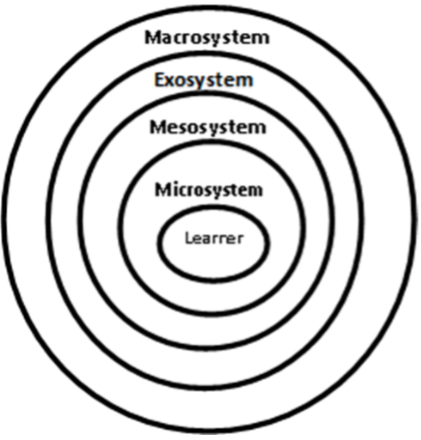
There are multiple dimensions to the interactions that can influence a person. Bronfenbrenner (1977) developed a framework for understanding how the interactions occur and how factors influence interactions. He adopted Orville G. Brim Jr.’s (1975) terminology of the micro-, meso-, and macro-structure and formulated his microsystem, mesosystem, exosystem, and macrosystem. Together, these offer a series of nested and interconnected structures within which an individual develops (Rosa & Tudge, 2013). Below in Figure 1 is a typical ecological systems framework diagram, showing a small ring in the centre with concentric rings fitting neatly over each other.
This framework serves as a tool for analyzing human development and, in this paper, school experiences, especially, of those with dyslexia – a specific learning difficulty affecting the fluency and accuracy of reading and spelling (BDA, 2023). Because of its associated challenges, dyslexia can affect a learner beyond the school system, where reading and writing are performed to a greater extent.
Figure 1. Visual illustration of the ecological systems framework (Nnamani, 2024).
Microsystem
The microsystem is the innermost structure of the ecosystem. It is described as “a pattern of activities, social roles and interpersonal relations experienced by the developing person in a face-to-face setting” (Bronfenbrenner, 1996, p. 1645). Social and symbolic features are shared through sustained and progressively complex interactions with the person’s immediate environment. An individual’s immediate environment, such as their home, school, community, and other social/cultural organizations, can be a powerful system in shaping their experiences and development (Emerson et al., 2012). Children are taught social roles and certain values at home, in school, and in the communities with which they are associated. Learning occurs naturally through proximal processes and social conversations (Bronfenbrenner, 1977). From an early age, a person’s impressions of self and their values can be formed by reciprocal interactions with the people in their microsystem. A positive experience can serve as a source of security and confidence – protective factors for growth. A negative experience can harm a person’s way of seeing the world around them.
As learners with dyslexia navigate the school system, they are expected to engage in reading and writing. Suppose when reading aloud, someone ridicules a learner with dyslexia for making a mistake. In that case, the result will be a negative experience, and the learner will do what they can to avoid reading in the classroom. The learner may even blame their dyslexia for the ridicule they receive in school, as Gunnel Ingesson (2007) demonstrates. Then, when the learner feels reluctant to read or refuses to read when asked to or engages in deviant behaviour as a way of masking their dyslexia challenges (Ingesson, 2007), this can affect the way others interact with them. A negative experience in school can affect the individual in another environment; for example, the child may refuse to read at home and be regarded as uncooperative and defiant. However, if parents support the child in the home by helping them to read, having reasonable expectations that the child can read well, and supporting their educational growth, the child will be more likely to overcome the challenges faced in school concerning reading, boosting their sense of achievement (Hoover-Demspey & Sandlers, 2005). However, the child with difficulties at school is likely to face additional challenges if they are not supported at home or when their struggles are not correctly identified at school. This will impair their learning development or school experiences until they receive support.
The interaction within the microsystem has been supported by many psychologists, including Lev Vygotsky (1934, 1978). Vygotsky’s sociocultural theory maintains that social interaction enhances learning and development: children learn and develop diverse skills through interaction with more knowledgeable members of their society. In his theory of psychosocial development, Erik Erikson (1958, 1963) refers to the role of others in shaping the child’s development and the potential of others causing lasting damage. However, Bronfenbrenner did not suggest that lasting damage can be caused by unresolved crisis. His theory emphasizes the role of the interconnection of the different systems in the individual’s development and that interactions become increasingly complex as two or more systems connect or influence one another.
Mesosystem
The relations between two microsystems – the mesosystems, such as the interaction between the family and the school – have the potential to solidify or threaten the individual’s experiences. Here, the individual is an active participant and can experience ecological transition, moving from one context to another. The ecological transition between the home and the school changes the individual’s role from child to learner. Bronfenbrenner (1977) suggests that this transition has consequences, and the individual’s experiences at home may differ from those at school. As explained above, for some learners with dyslexia, a negative experience in the classroom can stay with them, and they may avoid engaging in homework related to reading. Other learners with dyslexia, however, may not avoid engaging in homework despite a negative reading experience at school. The different reactions may be due to the individual’s level of support at home. The learner’s development also depends largely on how the school and family support the individual as they navigate their challenges. Studies have shown that such interaction can positively or negatively affect the learner’s general achievement (Arguea & Conroy, 2003; Fu et al., 2022).
Parents’ involvement in their child’s schooling can include attending parent-teacher meetings, reading and/or responding to correspondence from the school, or belonging to online social networks. Such involvement allows those supporting the child to help them with their reading collaboratively. Suppose the interaction between the family and the school is not productive, or the family does not connect with the school. In that case, the level of support that can be provided to the individual child may be inconsistent (Fu et al., 2022). The school experience of children who are supported at home and are well-prepared will likely be positive. On the other hand, a dearth of supports at home may interfere with their school development (Cooper et al., 2000; Fu et al., 2022). This suggests a need to balance the activities in the school and home environments. Joyce L. Epstein’s (1987, 1990; Epstein & Sheldon, 2006) model of overlapping spheres of influence suggests that the partnership between family, school, and community is crucial for boosting the child’s learning.
The interaction does not have to be face-to-face. Various forms of communication are used to pass information between the school and the home. These include emails, informative letters, and online social networks. As with the broader ecological theory, communication breakdown can threaten all parties. A parent who does not have the resources to read the information on a social network (e.g., access to a computer/smartphone) may not be up to date with information about their child’s school. This can result in the child missing out on certain school activities. On the other hand, parents cannot access vital information if the school does not disseminate such information. In this case, they will find it difficult to support their child.
Exosystem
Ecological systems theory posits that just as an individual can be affected by interactions between two microsystems, they can also be affected by “linkages and processes taking place between two or more settings” (Bronfenbrenner, 1993, p. 24). Bronfenbrenner further suggests that the settings do not have to include the individual for the processes or outcomes to affect the individual and their microsystem as long as the proximal processes from someone in their microsystem are there to make it happen. He terms this the exosystem.
The exosystem relates to the environment that is external to the individual but not to a significant other in the individual’s microsystem. For example, in the home, this could be a family problem unknown to the child, a change in a parent’s employment status, or a stressful event in the parent’s life. At school, this could be a change in the policies that might require teachers to spend less time supporting children with disabilities and more time teaching core subjects.
Learners with dyslexia may be indirectly affected by the actions or inactions of the parents at home or the teachers at school. For example, we can refer again to a child ridiculed at school for their reading capacity. Parents experiencing work-related stress or unemployment may be distracted and unable to fully address their child’s needs. Parents’ stress can distract them from effectively supporting their children. At school, teachers’ work-related stress and lack of time may influence how much time they can give to the struggling learner. Ecological systems theory suggests that while the school, as a social structure, affects development, the impact the social structure has on the learner may be due to wider systemic issues (Heinrich, 2014).
Macrosystem
Bronfenbrenner (1979) indicates that (on a much broader scale) an individual can be affected by society and the cultural belief systems underpinning certain interactions. The macrosystem – the outermost layer of the structure – is defined as the “societal blueprint for a particular culture, subculture or the other broader social context” (Bronfenbrenner, 1989, p. 228). These blueprints are very different from the exosystem. They do not relate to the individual’s specific environment; rather, they are marked by societal events and beliefs and have the potential to change over time. The socialization of individuals depends on what society presents as the norm at a given time. However, a paradigm shift may not be felt without making comparisons of individuals within different social contexts (Bronfenbrenner, 1974). Paradigm shifts over the years have resulted in the use of less degrading words to describe people with a disability.
For example, previously, such labels as ‘mentally handicapped,’ ‘maladjusted,’ and ‘ineducable’ were used to refer to people with disabilities (The Warnock Report, 1978; Lindsay et al., 2020). Such labels are not necessarily outmoded in some Sub-Saharan African countries like Uganda and Kenya (Aley, 2016; Rohwerder, 2018). The educational opportunity for learners with special educational needs in some Sub-Saharan African countries is still overwhelmingly behind, based on reports of learners struggling to access quality education in mainstream school settings (Amelina et al., 2023). Quentin Wodon et al. (2018) report that children struggle in enrolment, attainment, and learning.
Chronosystem
Bronfenbrenner’s ecological systems theory has been redefined over the years to include a fifth layer: the chronosystem. This refers to patterns of environmental events that occur over a lifetime and ever-changing socio-historical circumstances. For some children with dyslexia, this could be moving to another school familiar to them or the transition from primary to secondary school. The sudden loss of a loved one or parents’ separation can shape the individual’s development, while displacement can also affect development.
For example, the Global Education Monitoring Report (2019) indicates that 1 in 4 international migrants in Africa are children, a total of 6.5 million children. Displacement affects not only a child’s physical development but also learning (Internal Displacement Monitoring Centre, 2010; UNHCR, 2022). Similarly, a child who moves home or relocates from one country to another, may find that it is difficult initially to adjust to the education system in the new environment (Fiori, 2021), particularly in the absence of effective transition.
Gaps in Ecological Systems Theory
Ecological systems theory has been used extensively in scholarship to explore key issues in education as it offers a holistic understanding of the relationships between humans and their environment. Examples of such studies include a South African study by Nombuso Tebele and John Chaka (2024), which explores teachers’ perceptions of supporting learners with learning barriers, including dyslexia and dysgraphia in a rural school. They established that a number of factors affect supporting learners with learning barriers, including lack of parental support, inflexible curriculum, and overcrowded classrooms. The study suggests that while the microsystem (overcrowded classrooms) can play a key role in dismantling barriers, mesosystem (parental support), and exosystem (delay and bureaucracy leading to lack of support) play a role also.
Similarly, Mary Claessen et al. (2020) researched educators’ perception of the impact of reading difficulties for young people in Australia as well as their experiences in providing reading support to the learners. This study involved semi-structured interviews with 20 educators. The findings indicate that while the participants had knowledge of dyslexia, they had not enough to draw from evidence based to inform their practice. It also established a lack of reflection on the educators’ part on the appropriateness of the educational support as well as its effectiveness. The finding reveals the complexity teachers face in supporting learners with dyslexia in the absence of training. Further, while immediate classroom challenges (microsystem) can have an impact on the mental health of young people, a greater risk is driven by a wider issue that may not even be directly linked to the individuals. The research uncovered the educators’ perceptions of the young people’s response to their diagnosis is of “shame” and “difference” (p. 60) caused by the societal belief system about dyslexia and reading difficulties (macrosystem).
Extending previous dyslexia research, Peta Leitão et al. (2017) explored the factors that protect or place children at increased risk of mental health problems, with a specific focus on the lived experiences of the participants (children with dyslexia and their parents). A total of 34 participants were involved in the study (21 parents and 13 children between ages 10 and 16). The researchers established that while there are a variety of factors located in different layers of systems that can affect the lived experiences of learners with dyslexia, perspectives differ between the children cohort and parent cohort. For the children, the microsystem – including pre and post diagnostic experiences, school/class experiences, and comparison between peers – were factors that impacted their mental health. For some children, a dyslexia diagnosis offered reassurance that they were not in fact “dumb,” while others saw the diagnosis as an additional burden they must contend with for the rest of their lives. For most of the participants, accepting a dyslexia diagnosis came with the acceptance that adjustment within the microsystem (asking teachers for help in class) was required. On the other hand, the parents identified challenges and opportunities for supporting the mental health of their dyslexic children. On the parents’ part, there was a recognition of the role of school and support network (mesosystem) in acting as a protective factor. Parents identified risk factors beyond the microsystem, such as the lack of teacher training (exosystem), tension associated with societal belief systems relating to dyslexia. The finding suggests that both parents and children recognized the crucial role of the micro and mesosystems, and that micro and mesosystems challenges can mirror each other in comparison to other systems.
A similar finding was noted by Nnamani (2024) in a systematic literature review of seven research papers written between 2015 and 2021 on the factors affecting the learning experiences of learners with dyslexia in mainstream schools in England. The result showed that while several factors can influence the learning experiences of learners with dyslexia in English mainstream schools, the factors were dependent on education policies, which in turn, are influenced by societal belief systems about dyslexia which, in turn, shape policy design (macrosystem). The review suggests that where there is a lack of teachers training (exosystem), it is because of a lack of specificity and consistency relating to training in policy implementation (macrosystem) which, in turn, affect the quality and type of classroom intervention given(microsystem). Likewise, there is a need for policies (macrosystem) to strengthen the parents and school partnership and professional collaboration (mesosystem).
Note that although these studies mentioned provided great insight into understanding the complex interactions that exist between different systems, there is a dearth of reflection on the extent to which one system plays a more significant role or exerts a greater risk or protective factor than other systems. Perhaps this could be because Bronfenbrenner himself was more concerned about the roles played by the different layers of systems rather than the individual systems (Christensen, 2016; Dean et al., 2006). However, researchers’ failure to explore the severity of risk or opportunity one system can have over another can result in a gap in addressing the issues affecting individuals’ development. The systematic literature review suggests that the macrosystem has a major influence in shaping the learning experiences of learners with dyslexia in mainstream schools. However, the extent to which other systems exerted risk or protective factors was not explicitly stated.
Another observation is that some research papers using the EST framework have a poor or limited application of EST, as evidenced by Kristy Burn et al. (2015) who in a review of 349 articles published in the school psychology review showed that only a few (33.2%) of the papers considered the multiple environments with which the individual interacts. While this is not specific to dyslexia research, it shows that in some cases, ecological systems theory may not be comprehensively explored. With such limitations, it can easily be assumed that all the systems are equal in exerting risk factors or protective factors when this may not be the case. Referring once more to the child ridiculed at school, one may assume that the learner’s refusal to read may largely result from dyslexia and the bullying within their microsystem and not necessarily due to how the person perceives the bullying and how much value they accorded to reading. Knowing the different likely causes of the refusal to read would help to tailor effective supports that would help the learner thrive.
Referencing once more to the mesosystem level involving parents and school interactions, it may be seen as if it is the interaction that shapes experiences. However, there is research evidence showing that such interaction requires some thought process or active decision-making (Hoover-Dempsey & Sandler, 2005). Parental self-efficacy to help the child succeed (Hoover-Dempsey & Sandler, 2005; Chang et al., 2015) is also a factor. Here, the parental construction of their self-efficacy can be a motivation that influences parents’ behaviour in the parent-school interaction (Hoover-Dempsey & Sandler in Whitetaker, 2019). The authors also note that the value parents place on education can be a prerequisite for the child’s success. In contrast, where there is a lack of value for the child’s education, or where parents experience challenges navigating the school system, this might influence their level of involvement, which in turn might affect the child. It shows that internal processing of the individuals in the lives of the child may influence the individual’s experiences. Parental self-efficacy is important in helping the child develop and grow during challenging times (Bandura, 1977).
While the value placed on schools can be a protective factor, challenges in navigating an education system or getting answers from school staff may be risk factors and, in turn affect the student. Thus, it can be argued that the interaction within and outside the school may influence how schools respond to the needs of children with dyslexia in the school. From the microsystem to the macrosystem, the extent to which the decisions happening at different levels affect individuals is not clear in ecological systems theory. To get a clear understanding, how the different systems exert risk or protective factors, it is imperative to bring in a force field analysis. In this context, Kurt Lewin’s (1942) force field analysis can be useful for considering ecological systems theory.
Force Field Analysis
Kurt Lewin (1935), a renowned social psychologist, was one of the first theorists to investigate the impact of the environment on behaviour in his field theory. Bronfenbrenner highly respected Lewin’s field theory, which posits that there are psychological forces (or vectors) around individuals or groups of people with the potential to influence behaviour. The forces (or vectors) work by pushing the individual towards a goal or restraining the individual from reaching a goal. Lewin refers to the value placed on the goal as ‘valence.’ A positive valence is the desired goal, and a negative valence threatens the individual. Both the forces and the valence are located in the individual’s life space. The ‘life space’ is the totality of the facts/experiences that shape behaviour. Kiaras Gharabaghi and Carol Stuart (2013) conceptualize life space in four dimensions: physical, relational, virtual, and mental. The physical and mental dimensions are relevant to this research. The physical environment, such as the school, home, and community, links with the mental dimension – the mental processes the young person experiences in the physical setting.
For example, a learner with dyslexia struggling in a mainstream classroom because of their reading difficulties is removed from that classroom and placed in a class with other learners who have reading difficulties. The individual’s perception of this change will determine how they react. If they regard this move as an opportunity to learn in a small group away from others (a positive valence), then the individual may not be too bothered by it. However, a learner who sees the change as a negative move, creating a divide between them and their peers (a negative valence), may resent the change. The forces are the things that make the individual reach that assumption, i.e., children in different groups are ridiculed, or children in a smaller group do better in reading. The child may not consider the school as a safe space. Therefore, the outcome is not produced by the children’s interactions with the physical life space alone but by their thought processes – their perception of what is happening in their environment (or mental life space).
Lewin (1935) posits that a positive force led by a positive experience makes a person want to persist and move towards positive valence. This is often to satisfy a need. A negative force threatens the individual’s psychological state and may hold them back. An individual who is moved by a positive valence but finds a barrier from a negative force may experience tension, while those in a region of a negative valence who encounter a negative force may become reclusive. As forces or vectors determine the behaviour displayed, if confronted by a restraining force while striving for a positive valence, a person would need strong motivation to persist on a certain path. Lewin’s pursuit of scientific rigour encouraged him to use mathematics and scientific formulae to explain his concepts in his work. B= f (p-e) shows that behaviour (B) is a function (f) of a person (P) and their environment (E) (Burnes & Cooke, 2013). There are strong similarities between Lewin’s theory and Bronfenbrenner’s ecological systems theory. Lewin recognises that individuals do not possess a single life space but inhabit separate life spaces – work, home and school. Within the life spaces, psychological forces may influence the person’s behaviour and experiences.
Following Lewin’s scientific approach, ecological systems theory can be explained by the formula: D=f (p.e). Individual development (D) is a function (F) of an interaction between the person (P) and their environment (E) (Burnes & Cooke, 2013). When applied to learners with dyslexia, it suggests that school experiences are not only shaped by their interactions with different layers of systems, but also by the forces they encounter from those interactions as well as their region of valence. A learner in a positive region of valence who views an interaction as positive can navigate the school without complexity compared to those who do not.
Lewin’s theory is particularly useful alongside EST because it provides a broad and thorough understanding of why some individuals may have similar experiences but different responses, as well as which systems exert more forces over others and as such points towards where intensive intervention is required. However, while some researchers draw attention to ecological systems theory in analyzing the relationship between learners’ lives and their school achievement (Whipple et al., 2009), not much research uses these two theories together. Garry Squires and Anthoula Kefallinou (2019) use the ecological systems framework and force field theory to analyze the solution to school failures in the European Union. They found that forces associated with school failures push and pull the individual between school success and failure. It was evident that forces in the macrosystem had more potential to push and pull the individual towards or away from school success. This was because of the power that feeds into the school systems at the family and individual levels. The findings suggest that school failure needs to be addressed at a social level. This can be achieved by putting structures in place and making policy changes to help society deal with the situation better (macrosystem). From a micro- and mesosystem perspective, forces concerning parents’ engagement, teacher–learner relationship and teachers’ perceptions have the potential to push and pull the individual between school success or failure.
Conclusion
This paper set out to discuss how ecological systems theory and force field analysis theories can enhance the understanding of school experiences of learners with dyslexia. The paper has shown that the framework provided by the ecological systems and force field theories can be particularly useful for investigating the effect of interactions that shape the experiences of learners with dyslexia in mainstream schools and how interactions can be improved for a positive experience. The theories can enable researchers to consider how interactions with ecosystems affect individual learners. While school experiences result from interactions between systemic structures and environmental factors, the learner (and their thought processes), policymakers, school practitioners, and families – all of whom have direct or indirect contact with the individual’s life – can impede or enable positive school experiences. Drawing on Lewin’s theory, this paper suggests that achieving a positive learning experience (valence) is determined by various forces (positive and restraining) occurring in the different layers of systems (in and outside the school) and how the forces are processed by those affected. On the other hand, forces in the exo- and macro-systems can influence the behaviours of teachers, parents, and those with whom the learners with dyslexia come in contact. The outcome depends on how those individuals perceive the forces and their desired goals and how those with whom they interact view their challenges. The outcome also depends on factors in the learner’s life space and whether these push or pull certain behaviours. Restraining forces will hinder positive experiences, limiting what both the learner and the individuals around the child can achieve, while positive forces will have the opposite effect.
Implications for Future Research
This paper has argued that although individuals’ interactions with their environment shape their learning experiences, the extent to which the environment shapes the learning experience depends on the forces in the individual’s life space and the life space of those with whom they interact. Such forces influence decisions made by all parties. For a positive school experience for learners with dyslexia, it is important to recognise the forces and the location from which the forces are coming, as well as the impact they have on individuals. Doing so will help to tailor effective supports that would improve experiences for the learners. Therefore, it is imperative for future researchers not to look at ecological systems theory in isolation. While considering how development occurs through interaction with the ecosystems, perhaps it is worthwhile to consider to what extent the different systems have an impact on the individual and to recognise that some forces may be more significant than others. These may be located within different layers of systems and may need greater consideration when including learners with dyslexia in mainstream schools. This will help to understand forces within schools, and beyond, that promote or impede positive learning experiences.
References
- Aley, R. (2016). An assessment of the social, cultural and institutional factors that contribute to the sexual abuse of persons with disabilities in East Africa. Advantage Africa. https://www.advantageafrica.org/file/advantage-africa-sexual-abuse-research-summary-pdf
- Amelina, N., Migeon, F., Sass, J., Zhan, T., & Wodon, Q. (2023). Inclusive education: Researching children with disabilities in Africa. UNESCO. https://www.iicba.unesco.org/en/node/92
- Arguea, M. N., & Conroy, J. S. (2003). The effect of parental involvement in parent-teacher groups on students’ achievement. The School and Community Journal, 13(2), 119–136.
- Bandura, A. (1977). Self-efficacy: Toward a unifying theory of behavioural change. Psychological Review, 84(2), 191–215.
- Brim, O. G. (1975). Macro-structure influences on child development and the need for childhood social indicator. American Journal of Orthopsychiatry, 45(4), 516–524. https://doi.org/10.1111/j.1939-0025.1975.tb01182.x
- Bronfenbrenner, U. (1974). Developmental research, public policy, and ecology of childhood. Child Development, 45(1), 1–5.
- Bronfenbrenner, U. (1977). Towards experimental ecology of human development. American Psychologist, 32(7), 513.
- Bronfenbrenner, U. (1979). The Ecology of Human Development: Experiments by Nature and Design. Cambridge: Harvard University Press.
- Bronfenbrenner, U. (1989). Ecological systems theory. Annals of Child Development, 6(1), 187–249.
- Bronfenbrenner, U. (1993). The ecology of cognitive development: Research models and fugitive findings. In R. H. Wozniak & K. W. Fischer (Eds.), Development in Context: Activity and Thinking in Specific Environments (pp. 3–44). New Jersey: Lawrence Erlbaum.
- Bronfenbrenner, U. (1996). The Ecology of Human Development: Experiments by Nature and Design. Harvard University Press.
- Burnes B., & Cooke B. (2013). Kurt Lewin’s field theory: A review and re-evaluation. International Journal of Management Reviews, 15, 408–425. https://doi.org/10.1111/j.1468-2370.2012.00348.x
- Chang, M., Choi., N., & Kim, S. (2015). School involvement of parents or linguistic and racial minorities and their children’s mathematics performance. An International Journal on Theory and Practice, 21(3), 209–231. https://doi.org/10.1080/13803611.2015.1034283.
- Christensen, J. (2016). A critical reflection of Bronfenbrenner’s development ecology model. Problems in Education in the 21st Century, 69(1), 22–28.
- Claessen, M., Dzidic, P., Boyes, M., Badcock, N., Nayton M., & Leitão, S. (2020). Educators’ perceptions of the impact of reading difficulties for young people, Australian Journal of Learning Difficulties, 25(1), 51–64. https://doi.org/10.1080/19404158.2020.1734952
- Cooper, H., Lindsay, J. J., & Nye B. (2000). Homework in the home: How student, family and parenting-style differences relates to the homework process. Contemporary Educational Psychology, 25, 464–487. https://doi.org/10.1006/ceps.1999.1036
- Dean, V. J., Burns, M. K., Grialou, T., & Varro, P. J. (2006). Comparison of ecological validity of learning disabilities diagnostic models. Psychology in the School, 43(2), 129–246. https://doi.org/10.1002/pits.20143
- Dyslexia. (2023). British Dyslexia Association. https://www.bdadyslexia.org.uk/dyslexia
- Emerson, L., Fear, J., Fox, S., & Sanders, E. (2012). Parental Engagement in Learning and Schooling: Lessons from Research. Canberra: Australian Research Alliance for Children and Youth for the Family-School and Community Partnerships Bureau.
- Epstein, J. L. (1987). Toward a theory of family-school connections: Teacher practices and parents’ involvement across the school years. In K. Hurrelmann, F. Kaufmann & F. Losel (Eds.), Social Intervention: Potential and Constraints (pp. 121-136 -). New York: Walter de Gruyter.
- Epstein, J. L. (1990). Single parents and the schools: Effects of marital status on the parent and teacher interactions. In M. Hallinan (Ed.), Change in Societal Institutions (pp. 91–121). Plenum.
- Epstein, J. L., & Sheldon, S. (2006). Moving forward: Ideas for research on schools, family and community partnerships. In C. Conrad & R. Serlin (Eds.), Handbook for Research in Education: Engaging Ideas and Enriching Inquiry (pp.116-138). Thousand Oaks: Sage.
- Erikson, E. H. (1958). Young Man Luther: A Study in Psychoanalysis and History. New York: Norton.
- Erikson, E. H. (1963). Youth: Change and Challenge. New York: Basic Books.
- Fiori, F. (2021). Moving home during childhood: Is it harmful? Centre for Population Change. https://www.cpc.ac.uk/docs/2021_PB65_Moving_home_during_childhood_is_it_harmful.pdf
- Fu, W., Pan, Q., Yuan, Y., & Chen, G. (2022). Longitudinal impact of parent-teacher relationship on middle school students’ academic achievements in China. Frontier in Psychology, 13, 2–14. https://doi.org/10.3389/fpsyg.2022.872301.
- Gharabaghi, K., & Stuart, C. (2013). Right Here, Right Now: Exploring Life-Space Intervention for Children and Youth. Toronto: Pearson.
- Global Education Monitoring Report (2019). Global education monitoring report-migration, displacement and education: building bridges, not wall. UNESCO. https://doi.org/10.54676/XDZD4287
- Haeckel, E. (1866). Biogenetic law. In E. M. Barnes (Ed.), Ernst Haeckel’s Biogenetic Law 1996. Embryo Project Encyclopaedia (online source). https://hdl.handle.net/10776/7825
- Heinrich, J. C. (2014). Parents’ employment and children’s wellbeing. The Future of Children, 24(1),121–146.
- Hoover-Dempsey, V. K., & Sandler, H. M. (2005). The social context of parental involvement: A path to enhanced achievement. Institute of Education Sciences. https://ir.vanderbilt.edu/bitstream/handle/1803/7595/OERIIESfinalreport032205.pdf?sequence=1&isAllowed=y
- Ingesson, G. S. (2007). Growing up with dyslexia: Interviews with teenagers and young adults. School Psychology International, 28(5), 574–591. https://doi.org/10.1177/0143034307085659
- Internal Displacement Monitoring Centre. (2010). Briefing paper on the right to education of internally displaced people. https://api.internal-displacement.org/sites/default/files/publications/documents/2010-learning-in-displacement-thematic-en.pdf
- Kumar R. P., & Singh J. S. (2020). Invasive alien plant species: Their impact on environment, ecosystem services and human health. Ecological Indicator, 111. https://doi.org/10.1016/j.ecolind.2019.106020
- Leitão, S., Dzidic, P., Claessen, M., Gordon, J., Howard, K., Nayton, M., & Boyes, M. E. (2017). Exploring the impact of living with dyslexia: the perspectives of children and their parents, International Journal of Speech-Language Pathology, 19(3), 322–334. https://doi.org/10.1080/17549507.2017.1309068
- Lewin, K. (1935). A Dynamic Theory of Personality. New York: McGraw-Hill.
- Lewin, K. (1942). Field Theory and Learning. Teachers College Record, 43(10), 215–242. https://doi.org/10.1177/016146814204301006
- Lindsay, G., Wedell, K., & Dockrell, J. E. (2020). Editorial: Warnock, 40 years on: Challenges for special educational needs. Frontiers in Education, 5, 1–3. https://doi.org/10.3389/feduc.2020.00010
- Nnamani, G. (2024). An ecosystemic perspective of the factors affecting the learning experiences of learners with dyslexia in mainstream schools in England. Dyslexia, 30(3), 1–17. https://doi.org/10.1002/dys.1768
- Polit, D. F, & Beck, C. T. (2010). Generalization in quantitative and qualitative research: myths and strategies. International Journal of Nursing Studies, 47(11), 1451–1458. https://doi.org/10.1016/j.ijnurstu.2010.06.004.
- Rohwerder, B. (2018). Disability stigma in developing countries. Knowledge, Evidence and Learning for Development. https://assets.publishing.service.gov.uk/media/5b18fe3240f0b634aec30791/Disability_stigma_in_developing_countries.pdf
- Rosa, E. M., & Tudge, J. (2013). Urie Bronfenbrenner’s theory of human development: its evolution from ecology to biology. Journal of Family Theory & Reviews, 5: 243–258. https://doi.org/10.1111/jftr.12022
- Shackleton R. T., Shackleton C. M., & Kull C. A. (2019). The role of invasive alien species in shaping local livelihoods and human well-being: A review. Journal of Environmental Management, 229: 145–157. https://doi.org/10.1016/j.jenvman.2018.05.007
- Squires, G., & Kefallinou, A. (2019). Preventing School Failure: A Review of the Literature. Odense: European Agency for Special Needs and Inclusive Education.
- Tebele, N., & Chaka, J. (2023). Exploring teachers’ perceptions when supporting learners with dysgraphia and dyslexia in a rural school. International Journal of Studies in Psychology, 4(1), 15–28. https://doi.org/10.38140/ijspsy.v4i1.1057.
- United Nations High Commissioner for Refugees (UNHCR). (2022). Evidence on learning outcomes for refugees: A rapid review. https://www.unhcr.org/media/evidence-learning-outcomes-refugees-rapid-review
- Whitetaker, C. M. (2019). The Hoover-Dempsey and Sandler Model of the Parental Involvement Process. In S. B. Sheldon & T. A. Turner-Vorbeck (Eds.), The Wiley Handbook of Family, School and Community Relationships in Education (pp. 421–443). New Jersey: John Wiley & Son Inc. https://doi.org/10.1002/9781119083054.
- Whipple, S. S., Evans, W. G., Barry, L. R., & Maxwell, E. L. (2009). An ecological perspective on cumulative school and neighbourhood risk factors related to achievement. Journal of Applied Developmental Psychology, 31 (2010), 422–427.
- Warnock, M. (1978). Special Educational Needs: Report of the Committee of Enquiry into the Education of Handicapped Children and Young People. London: Her Majesty's Stationery Office.
- Wodon, Q., Male, C., Montenegro, C., & Nayihouba, A. (2018). The Challenge of inclusive education in Sub-Saharan Africa. The Price of Exclusion: Disability and Education. Washington, DC. http://hdl.handle.net/10986/31005
- Vygotsky, L. S. (1934). Thinking and Language. Transl. Behruz Azabdaftari (1998). Tehran: Nima Publication.
- Vygotsky, L. S. (1978). Mind and Society: The Development of Higher Psychological Processes. Cambridge: Harvard University Press.