“If We Had an Option, We Wouldn’t Be Here”: Revisiting Inclusive Education for Learners with Visual Disabilities in Ghana
« Si nous avions le choix, nous ne serions pas là. » : repenser l’éducation inclusive pour les apprenantes et apprenants ayant une déficience visuelle au Ghana
Abigail Adubea Mills, PhD
University of Ghana, Legon
aamills [at] ug [dot] edu [dot] gh
Anthony Oduro, MPhil
University of Ghana, Legon
Andrews Berchie, MPhil
University of Ghana, Legon
Abstract
Following a long history of segregated special education for children with disabilities, recent decades have witnessed a move by the global community to promote inclusive education. Successive Ghanaian governments have made some effort towards implementation of various forms of integrated and/or inclusive education for learners with disabilities. This paper reports partial findings from a broader study that explored inclusive education in Ghana. Although integrated senior high schools have been in existence in Ghana for decades, some challenges have persisted over the years. Using a qualitative research design, 21 learners with visual disabilities in two integrated senior high schools in Ghana were sampled. Data was collected using individual in-depth interviews and transcribed interviews were analyzed using thematic network analysis. The challenges disclosed by the participants are discussed under three broad themes: the physical environment; negative attitudes from some peers and teachers without disabilities; as well as challenges related to teaching and learning. The persistence of these challenges in contemporary Ghana is a call on all stakeholders to reflect and take action towards enhancing the experience of inclusive education by learners with visual disabilities in the country.
Keywords: Visual Disabilities, Inclusive Education, High School, Ghana, Qualitative Research
Résumé
À la suite d’une longue histoire d’éducation spécialisée ségréguée pour les enfants handicapés, les dernières décennies ont vu la communauté internationale promouvoir l’éducation inclusive. Les gouvernements ghanéens successifs ont entrepris des efforts pour mettre en œuvre diverses formes d’éducation intégrée ou inclusive pour les apprenantes et apprenants handicapés. Cet article présente des résultats partiels d’une étude plus vaste sur l’éducation inclusive au Ghana. Bien que des écoles secondaires intégrées existent depuis plusieurs décennies, plusieurs défis persistent. En adoptant un devis qualitatif, 21 apprenantes et apprenants ayant une déficience visuelle inscrits dans deux écoles secondaires intégrées ont été recrutés. Les données ont été recueillies par entrevues individuelles approfondies, puis analysées au moyen d’une analyse thématique en réseau. Les défis rapportés par les participantes et participants se regroupent sous trois thèmes : l’environnement physique, les attitudes négatives de pairs et du personnel enseignant sans handicap, ainsi que les difficultés liées à l’enseignement et à l’apprentissage. La persistance de ces enjeux dans le Ghana contemporain appelle l’ensemble des parties prenantes à réfléchir et à agir pour améliorer l’expérience de l’éducation inclusive des apprenantes et apprenants ayant une déficience visuelle.
Mots-clés : Déficience visuelle, éducation inclusive, école secondaire, Ghana, recherche qualitative
Introduction
Education is widely recognized as a means to develop human capital, improve economic performance, and enhance capabilities and choices. These benefits of education apply to all persons, with and without disabilities. It is, therefore, imperative that educational experiences are well-planned for all learners, including those with disabilities. Inclusive education has been at the heart of discourses on the education of persons with disabilities, championed as an alternative to segregated education (UNICEF, 2019). The United Nations’ Sustainable Development Goal 4 particularly emphasizes the need for countries around the world to foster inclusion in education (United Nations, 2015) and contributed to the impetus previously generated by UNESCO’s Education for All agenda. The philosophy of inclusive education is therefore embraced at the international level.
Inclusive education involves the placement of students who were previously excluded from education, such as persons with disabilities, in general education classrooms in regular community schools with the necessary supports (Chitiyo et al., 2024; Nilholm & Göransson, 2017). Nonetheless, studies indicate that simply placing learners with disabilities in the regular schools and classrooms alone is not enough to “achieve” inclusive education (Adera & Assimeng, 2011; Asamoah et al., 2018; Maguvhe & Mutambo, 2023; Mantey, 2017). Social, cultural, and economic factors also greatly influence the implementation of inclusive education (Asamoah et al., 2022; Mills, 2018). Outcomes such as good relations with peers without disabilities, participation in school activities, curriculum adaptation, academic achievement, and positive teacher attitudes are among the indicators of successful implementation of inclusive education (Chitiyo et al., 2024; Nilholm & Göransson, 2017).
Ghana is among countries in Africa that have embraced the philosophy of inclusive education and continue to put in efforts to successfully implement it (Asamoah et al., 2018; Grimes et al., 2023; Kristensen et al., 2006; Maguvhe & Mutambo, 2023; Opoku-Nkoom & Ackah-Jnr., 2023). However, in low- and middle-income countries, the zeal to implement inclusive education is often not commensurate with the resources available to implement it (Wapling, 2016). In Ghana, a typical example can be seen in the establishment of integrated senior high schools where learners with visual disabilities study alongside their peers without visual disabilities.
Special education in Ghana began in the 1940s when Basel missionaries established schools for students with visual impairments in Begoro and Akropong-Akwapim (Ametepee & Anastasiou, 2015). After Ghana gained independence in 1957 education became a national priority, and in 1959 the government passed a parliamentary bill to provide free education for students with physical and cognitive disabilities (Avoke, 2001). The Education Amendment Act of 1962 further supported this by empowering the Ministry of Education to create a Special Education Division, which focused on early identification, professional advice, teacher training, and support for students with disabilities (Avoke, 2001; Avoke & Avoke, 2004; Ghana Education Service, 1995; Torto, 2000).
Before the widespread adoption of inclusive education, some students with disabilities were integrated into regular schools. However, in this model, students with disabilities were expected to adjust to the general education environment, rather than the schools modifying their practices to accommodate their diverse needs (Sharma & Deppler, 2006; Mprah et al., 2015). The shift towards inclusive education in Ghana began in the 2003/4 academic year, with a focus on non-discrimination. The introduction of the 2006 Persons with Disability Act and Ghana’s ratification of the Convention on the Rights of Persons with Disabilities (CRPD) further strengthened this approach, ensuring that students with disabilities could study alongside their peers (Anthony, 2011; Ministry of Education, 2016). Despite these advances, challenges remained in implementing inclusive education, particularly due to the lack of a comprehensive policy. In 2015, the Ghana Government in partnership with UNESCO and UNICEF developed an Inclusive Education Policy to provide clear guidelines for schools and teachers. This policy reinforced the right of all school-age children, including those with disabilities, to receive high-quality education. It also acknowledged the diverse needs of such students and emphasized the importance of creating learning environments that cater for those needs (Republic of Ghana, 2015). For instance, students with visual disabilities – in integrated schools practising inclusive education – often are not allowed to take science and math classes. The reason generally given is that these subjects are difficult to adapt into accessible formats or specialized tools such as Perkins Braille and stylus.
Integrated schools are equipped with resource centres that provide learning materials in accessible formats (e.g., Braille textbooks and sheets, Perkins Braille, stylus, etc.) and serve as venues for special classes designed to support students who may be struggling with the regular classroom instruction. In these resource centres, specially trained teachers – who have completed special education programs at the university level – work with learners with visual disabilities to ensure that the learners can engage with the lessons and bridge any learning gaps. This integrated school system in Ghana is primarily set up for learners with visual disabilities to enable them to meet their senior secondary educational needs. As with several senior high schools in Ghana, integrated schools for students with visual disabilities have residential facilities for learners with and without disabilities.
For decades, integrated senior high schools in Ghana have served as the only options available to individuals with visual disabilities to access second cycle education, and yet, fundamental challenges continue to persist in these institutions. The main objective of this paper is to highlight some of the persisting challenges, by projecting the voices of learners with visual disabilities in two integrated senior high schools in Ghana.
Research Methods
The design for this study was qualitative, specifically adopting a phenomenological approach. Phenomenological research is “the study of lived or experiential meaning” and “may explore the unique meanings of any human experience or phenomenon” (Adams & van Manen, 2008, p. 614). This design generally seeks to understand phenomena as experienced by those who live it, hence this study targeting learners with visual disabilities who were experiencing some form of inclusive education.
The data for this paper is obtained from a broader study which examined various issues on inclusive education for learners with visual disabilities in one inclusive basic school and two integrated senior high schools in Ghana. However, this paper presents part of the findings relating to the experiences of learners with visual disabilities in the two integrated senior high schools, located in two different regions of Ghana. Each school had been in existence for more than two decades and well-known in Ghana as second cycle schools which provide education to both learners with and without visual disabilities.
Introductory letters were first sent to each school to commence formal introductions. Although the letters provided details about the intended research, delivering the letters personally allowed the researchers to meet with some key leaders in the school to discuss the research further. The Ethics Committee for the Humanities at the University of Ghana provided ethical approval for the study. The ethical principles of voluntary participation, anonymity, privacy, and no harm to participants were adhered to. Purposive sampling was used to select a total of 21 students with visual disabilities. Out of the selected students with visual disabilities, 17 were totally blind while 4 had partial blindness. None of the participants reported additional disabilities or had albinism. The inclusion criteria were that the student should have been in the integrated senior high school for at least two months and was willing to participate in the study. Participants’ ages ranged from 18 to 27 years. The age range falls outside of the typical range for senior high school students because, for most participants, the onset of the visual disability was not from early childhood. Following the onset of blindness or complications with vision in later childhood, sometimes, after their junior high education, they then enrolled into special education to re-learn several things before furthering their formal education as learners with visual disabilities.
Data was collected through individual in-depth interviews using a semi-structured interview guide designed by the lead researcher. Interviews lasted an average of forty minutes. Permission was sought from participants to audio-record the interviews. Interviews were conducted primarily in English, but some participants switched back and forth between English and Akan dialects, all of which were well understood by the researchers. To ensure confidentiality and anonymity of research participants, details in their profiles that may be used to identify them were eliminated or altered. In reporting the findings, participants were assigned labels such as ‘female learner 1’ and ‘male learner 4,’ and hence, there was concealment of the real names of the participants.
The data was analyzed using Attride-Stirling’s (2001) six steps of thematic network analysis. Following the transcription of the audio-recorded interviews and familiarization with the data, a coding framework was developed and applied to the entire text, after which themes were identified and refined. The next step involved construction of the thematic networks, followed by exploration of the text using the networks. The thematic networks were then summarized and the patterns interpreted. The global theme is captioned as challenges encountered in school; the organizing themes are physical environment, teaching and learning; and negative attitudes/unfair treatment. The basic themes are indicated along with the global and organizing themes in the thematic network presented in Figure 1. Each of these themes contains subthemes.
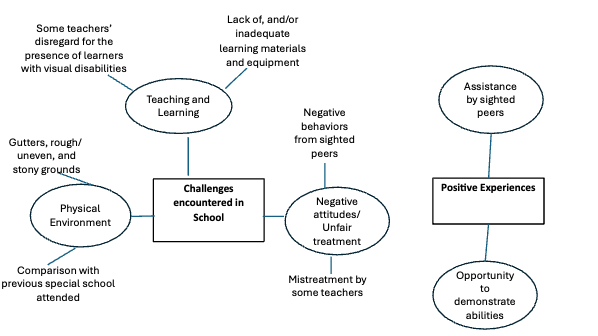
Figure 1. Two clusters in a thematic network. Connected to the square “Challenges encountered in school” are the circles “Physical Environment” (including “Gutters, rough/uneven, and stony grounds”; and “Comparison with previous special school attended”); “Teaching and Learning” (including “Some teachers’ disregard for the presence of learners with visual disabilities”; and “Lack of, and/or inadequate learning materials and equipment”); and “Negative attitudes/unfair treatment” (including “Negative behaviors from sighted peers”; and “Mistreatment by some teachers”). Connected to the square “Positive Experiences” are the circles “Assistance by sighted peers” and “Opportunity to demonstrate abilities.”
Global Theme: Physical Environment
One major challenge that participants talked passionately about was the state of the physical environments of their schools. Specifically, they lamented about gutters, stony and uneven grounds. Others drew comparisons between their current school and the previous special school they attended. These subthemes are discussed below.
Subtheme: Gutters, Rough/Uneven, and Stony Grounds
In Ghana, many construction projects – such as roads, gutters, and pavements – are often carried out without considering the specific needs of all potential users. For example, it is common to find open gutters along roads, no sidewalks, and rough terrains on school compounds and general spaces. These features make the physical environment difficult to navigate and unsafe for commuters, especially students with disabilities. This lack of consideration for the physical environment presents significant challenges to learners with visual disabilities, as reflected in the following quotes from participants:
I have fallen into a gutter and bruised my knees so badly. …Yesterday, I was going to the dining hall with a friend… it had rained, and we didn’t notice that there was a muddy patch ahead of us and we walked right into it! … All these are some of the disheartening things in our environment. (Female learner 4, School A, 26 years)
Just yesterday, when I woke up, I was going to bathe and our tap was not [flowing]. So, we had to walk a very long distance from our dormitory to the teacher’s bungalow. …I never knew I was very close to the gutter. So, I fell in the gutter, my bucket got spoilt and I got hurt. …So, the environment is not friendly to us. (Male learner 11, School A, 24 years)
I have challenges with this school, in terms of our roads. …Every day, every time I fall! I fall because of that gutter! It is not covered. I need that gutter covered! (Male learner 4, School A, 27 years)
While some participants raised concerns about uncovered gutters and construction debris, others expressed frustration over the absence of handrails along pathways on the school compound. These handrails, which are essential for schools practicing inclusive education, were notably absent at the study sites. As highlighted by the participants:
I don’t know if it was purposely meant for the sighted alone because the environment does not suit the visually impaired. …At the top [of a multi-storey residence] where the verandah is, we don’t have any handrails there. So, if a visually impaired student is going around and gets closer to the verandah, he might fall. (Male learner 1, School A, 27 years)
This school is inclusive, but not all that good for people with visual impairment because the roads leading to the classrooms are not good for the visually impaired, people normally hurt themselves… If you come inside the school, you get to know how we the blind suffer. …On the road leading to my house on the bridge, there is a [large] hole, which is not safe. You can enter the hole! (Male learner 2, School B, 21 years)
Beyond the lamentations about poor accessibility of the wider school premises, some participants also identified challenges related to classroom arrangements, including access to chairs and desks. In participants’ own words:
In the classroom, sometimes when we go, and there are not enough chairs, instead of the sighted students allowing us to take the available chairs so that they go for chairs from other places, they will let us stand until a teacher comes to appeal to them.… Sometimes when you place a chair at a spot, by the time you return, [the sighted students] would have moved it from there. (Female learner 4, School A, 26 years)
Yesterday for instance I went to class with no desk for us. (Male learner 2, School B, 21 years)
The challenges participants faced with the physical environment of the school made some of them draw comparisons with their former basic school, which was a special school for learners with visual disabilities.
Subtheme: Comparison with Previous Special School
Some participants expressed how different the situation was at their previous school, which was a special school. Special schools for learners with visual disabilities are typically structured to accommodate the needs of the learners. However, because integrated schools were originally designed without consideration for students with visual disabilities, there were disparities in the experiences of the participants regarding the two settings, i.e., special schools and integrated schools. This difference resulted in a longing for a learning environment which was akin to that which the participants experienced at the basic education level. Examples from our dataset below include comparison of physical conditions and opportunities for skills development:
As for [name of special school], we can’t compare it to this school. …Our gutters and our classrooms, our tables, were all on point (Female learner 5, School B, 20 years)!
This school is not meant for the visually impaired, but my former [special] school was made for the visually impaired. We could do everything on our own; here we do not sweep, we do not do anything. We leave it for the sighted to do, but in our former school, we were allowed to sweep. That helps you to be independent (Male learner 2, School B, 21 years).
My former [special] school was meant for the visually impaired, so we could do everything on our own. Here the chores are done by those who can see. …I don't know why they [sighted persons in the integrated school] see us as not being able to do things (Male learner 5, School A, 21 years).
Global Theme: Negative Attitudes and Unfair Treatment
Another major theme that emerged from the data was the experience of negative attitudes from some peers and teachers. Participants expressed that they were sometimes made to feel as though they would pass on blindness to their colleagues without disability through association.
Subtheme: Negative Behaviours from Sighted Peers
The unfair treatment experienced by the participants can be traced to negative cultural attitudes towards persons with disabilities in Ghanaian society. In some communities, disability is viewed as a punishment from a deity for sins committed by the individual or their family members, leading to the belief that the presence of people with disabilities is an ill omen. Others perceive disability as a contagious condition that can spread from one person to another, fueling stigma and mistreatment. These harmful beliefs contribute to the challenges faced by learners with visual impairments, as reflected in the participants’ comments below:
Those without disability do not relate with me well, just because some have not seen people with disability before. They are afraid to come close to you… People think it’s a disease that they can be infected with when they come closer to you. Sometimes they mock and laugh at you when we are passing by. (Male learner 10, School B, 21 years)
The [sighted] person can tell you, “I’m going.” And you will say, “Okay since you are going [to a specific part of the school], please take me along.” Then they will say, “I’m not even going again.” As you stand there, the people will just pass you by and go. Even today, it happened to one of our friends. (Female learner 2, School B, 19 years)
It's difficult, for us to socialize with the people with no visual impairment because… a lot of the sighted colleagues, they normally think if you come closer to them, you would transfer the blindness to them. (Male learner 7, School A, 21 years)
While many students reported negative attitudes from their peers without disabilities, one participant shared a troubling experience, which was that some sighted students stole from their colleagues with visual disabilities. She explained that their belongings are taken without permission:
We are also robbed a lot! The sighted, they steal from us! Before you realize, your things would be broken into and items robbed. …When I came here first as a fresh student, not knowing my way around, they stole all my clothing and pillow. (Female learner 3, School A, 20 years).
Subtheme: Mistreatment by Some Teachers
While several participants reported being ignored or mistreated by some teachers, two specific incidents stood out. The mistreatment by teachers further underscores the earlier discussion about the negative societal perceptions of persons with disabilities in Ghana. These issues are illustrated in the participants’ comments below:
Some teachers for instance do not want to relate with us, unless those who know that visual impairment is not a disease or evil… Last semester, I had a problem with a teacher. There was a roll call and, in this school, our resource person told us that when it is roll call we should not rush [to the converging point] as most of our sighted colleagues do, but that we should take our time and move since the environment is not safe for us. We were asked why we were late, and they started slapping us. (Male learner 2, School B, 21 years)
Some of the teachers too insult us nastily – like [calling us] useless. (Female Learner 4, School A, 26 years)
Global Theme: Teaching and Learning
The challenges related to teaching and learning have been grouped into two subcategories: some teachers’ disregard for learners with visual disabilities in the classroom, and inadequate learning materials and equipment.
Subtheme: Some Teachers’ Disregard for the Presence of Learners with Visual Disabilities
Disregarding learners with disabilities in the classroom may stem from various factors such as inadequate understanding of pedagogical approaches that could help all students in lessons or misconceptions about the abilities of learners with disabilities. The example narratives below depict some participants’ experiences in this vein, including experiences of teachers who need to be prompted to provide audio descriptions of textbook imagery and blackboard writing:
Some [teachers] also discriminate… The attention is always on the sighted colleagues. They don’t pay much attention to the visually impaired. So, sometimes we feel lonely, we are not part of the class. (Male learner 11, School A, 24 years)
Some of the teachers too, especially the sighted teachers, forget that although the sighted students are the majority, there are also students with visual impairments in the classroom. They will write on the board and talk about what has been written using “this” and “that.” …And in some cases, maybe a book is being used which has some drawings, then we will be called to “take a look.” (Female Learner 4, School A, 26 years)
Also, the teachers should slowly dictate because of our braille writing. We make mistakes in writing when the teachers dictate fast in class. (Female learner 1, School B, 25 years)
Subtheme: Lack of, and/or Inadequate Learning Materials and Equipment
Participants reported that there were inadequate teaching and learning materials. This situation could be attributed to insufficient funding for inclusive education. Although the government of Ghana, through the Ministry of Education, is responsible for providing these resources as outlined in the 2015 inclusive education policy, provision has been inadequate. As a result, the burden of providing teaching and learning materials often falls on parents, families, NGOs, religious and other charitable organizations, or individuals. Participants below commented on inadequate learning resources, including textbooks in Braille, laptops, and recording devices:
The sighted students have their books. They have maybe close to eight [subject-specific textbooks]… But we don’t have it that way. Though we may have a laptop to operate from, ask yourself whether all of us can afford the laptop. …So, we need the textbooks in a Braille form, in a textbook form so that we can compete with the sighted students. (Male learner 2, School B, 21 years)
I need a recorder to record lessons … so that I can listen to them when I go back to the dormitory. Sometimes when I tell my peers to read out for me, they say they are busy. This is challenging for me. (Female learner 1, School B, 25 years)
Global Theme: Positive Experiences
While challenges and negative experiences were reported, some students highlighted positive aspects of their education in mainstream schools. They appreciated the idea of learning alongside their peers without disabilities. Some participants mentioned that some of their non-disabled peers were a great source of support, helping by reading to them, accompanying them, and running errands, as reflected in the quotes below:
We have learned a lot from our peers without disabilities. Some are very loving and help a lot. Sometimes they can make your work easier. …They learn with us in class, and sometimes during our prep time, they read to us. So, it’s really helped us a lot, and we really admire that. (Male learner 2, School B, 27 years)
In some ways, [being in the integrated school] has really helped me. Some [sighted colleagues] can dictate notes for me or help me with my work. Others can help by fetching water, and some even take me to the dining hall and do other things like that. (Female learner 5, School A, 20 years)
If I'm looking for something and can’t find it, I can ask a sighted person to help me look for it. Also, when we were about to register for [transition exams from senior high school], there were certain things posted on the notice board. Since I couldn’t read them on my own, I would usually give my index number and name to a sighted colleague, who will tell me everything I need to know. (Female learner 2, School A, 19 years)
Some participants felt that simply being part of an inclusive environment challenged the negative narrative that people with disabilities cannot attend school or reach their full potential. These positive experiences highlight the potential of inclusive education when teachers and schools are equipped and committed to accommodating diverse learning needs. The examples below illustrate this point:
When you become visually impaired, the first thought that comes to mind is to isolate yourself. You even feel shy about coming out and socializing with people who can see. But with inclusive education, there’s nowhere to hide. You sleep in the same dormitory with them, you bathe with them in the same bathhouse, you go to class with them, you study with them, and that helps us to become more sociable. Yes. And I think it helps us, the visually impaired, learn a lot from those who can see. At the same time, we also get the opportunity to educate those who see about the positive things we can do. …Through inclusive education and other activities, we get the opportunity to show people what we’re capable of. And I think it helps erase misconceptions about the visually impaired. (Male learner 3, School B, 21 years)
Now people have knowledge about students with disabilities and understand that we are all equal, as we can do what they can do. (Male learner 5, School B, 28 years)
Discussion
Inclusive education is a human rights and social justice issue that entails ensuring equality of access and eliminating discriminatory practices (Ainscow & Sandill, 2010; Anthony, 2014). However, as revealed in this study, without deliberate efforts to make educational institutions inclusive, efforts towards implementing inclusive education could rather result in challenges for learners with disabilities, thereby making them prefer special (segregated) schools. Inaccessible physical environments have consistently featured in scholarship as a major barrier to participation for persons with disabilities (Adera & Asimeng-Boahene, 2011; Naami, 2019), a fact that the current study affirms. Ackah-Jnr and Danso (2019) arrived at a similar conclusion when they surveyed the physical environments of some inclusive schools in Ghana. They reported that the physical environments of most inclusive schools were of “poor quality”, “less accessible,” and “less suitable” for learners (Ackah-Jnr & Danso, 2019, p. 188).
Another important finding relates to unhealthy interpersonal relationships existing among learners with visual disabilities and some other members of the inclusive school. While human behaviours and reactions cannot always be predicted, it is important for members of inclusive schools to be regularly sensitized about the importance of creating a supportive environment for all learners, with and without disabilities. Findings of this study reflect to an extent, lack of understanding and empathy on the part of some learners and teachers without disabilities towards learners with visual disabilities. While negative attitudes could stem from genuine lack of awareness about a situation, some attitudes are also entrenched in societal perceptions about persons with disabilities, which creates a mental barrier to making the effort to co-exist in the same space with persons with disabilities. In Ghana, for example, cultural beliefs around disability frequently contribute to the stigma and discrimination faced by learners with visual impairments. Naami (2014), as cited in Oduro et al., (2023) notes that disability, which is traditionally viewed as a form of divine punishment, is believed to result from offending the gods through personal actions or familial transgressions. This perception fosters an environment where individuals with disabilities are not only marginalized but also subjected to negative actions and attitudes (Oduro et al., 2023). Consequently, some people distance themselves from persons with disabilities out of fear of divine retribution, while others may openly display hostility (Oduro et al., 2023).
Furthermore, several studies have shown that living with a disability attracts additional costs that individuals with disabilities would otherwise not have incurred if they did not have a disability (Berthoud, 1991; İpek, 2020; Mitra et al, 2017). Inclusive education for learners with disabilities similarly comes with unavoidable costs which must necessarily be borne to promote positive educational outcomes. While the government of Ghana heavily subsidizes educational costs in the public education system, the financial support towards inclusive (and special) education is woefully inadequate. Although there are no specific data on the funds allocated to support the implementation of inclusive education, the overall budget for the Education Ministry in 2024 was 29.5 billion Ghana Cedis, an increase of 6.6 billion in nominal terms from the preceding year, 2023 (Send Ghana, 2023). Despite this increase, some schools continue to lack the requisite resources for the implementation of inclusive education. The costs of equipment such as laptops, recorders and other devices required for effective learning by individuals with visual disabilities cannot be borne by average-income families, least of all learners from poorer backgrounds. Considering the significant returns that education provides as a human capital intervention, the needed investments need to be made.
Regardless of the numerous challenges that participants recounted about the integrated school setting, it was instructive to learn of some of the positive experiences that they had as well. This offers a glimmer of hope that if efforts towards including learners with disabilities in regular schools are well thought through, and the right physical and academic environments created, the anticipated benefits of inclusive education could be realised. The positive experiences of participants also present the opportunity to make a case for the continuity of inclusive education and its potential benefits for both learners with and without disabilities in Ghana.
Conclusion and Recommendations
Systemic and structural issues contribute to difficulties in the implementation of inclusive education in Ghana, and some of these difficulties lead to frustration of the educational endeavours of learners with disabilities. Findings of this study have indicated that poorly accessible physical environments, negative attitudes from peers and teachers, as well as inadequate teaching and learning materials create challenges that take away from the expected positive outcomes of inclusive education. Government and non-governmental entities need to recognize these age-old challenges and strategically address them in order to change the narrative about inclusive education in Ghana.
It is recommended that the government of Ghana, (through the Ghana Education Service), refocus its attention to the integrated senior high schools and work to improve the experiences of learners with visual disabilities in these institutions. At the school level, whole school orientations should consistently be carried out for all teachers and learners without disabilities to enable them to understand the uniqueness of the educational space they are in and to help enhance the educational experience for all, particularly, learners with visual disabilities. There is perhaps some opportunity to capitalise on the positive experiences of learners with disabilities in the promotion of inclusive education as an underlying philosophy of education in Ghana. However, this should be preceded by radical positive changes to the physical, academic and human resource environment of integrated schools to ensure that the educational experiences of learners with disabilities in Ghana are significantly improved.
References
- Ackah-Jnr, F. R., & Danso, J. B. (2019). Examining the physical environment of Ghanaian inclusive schools: How accessible, suitable and appropriate is such environment for inclusive education? International Journal of Inclusive Education, 23(2), 188–208.
- Adams, C., & van Manen, M. (2008). Phenomenology. In L. M. Given (Ed.), Sage Encyclopedia for Qualitative Research Methods (pp. 614–619). Thousand Oaks: Sage Publications Inc.
- Adera, B. A., & Asimeng-Boahene, L. (2011). The perils and promises of inclusive education in Ghana. The Journal of International Association of Special Education, 12(1), 28–32.
- Ainscow, M., & Sandill, A. (2010). Developing inclusive education systems: The role of organisational cultures and leadership. International Journal of Inclusive Education, 14(4), 401–416.
- Ametepee, L. K., & Anastasiou, D. (2015). Special and inclusive education in Ghana: Status and progress, challenges and implications. International Journal of Educational Development, 41, 143-152.
- Anthony, J. (2011). Conceptualising disability in Ghana: Implications for EFA and inclusive education. International Journal of Inclusive Education, 15(10), 1073–1086. https://doi.org/10.1080/13603116.2011.555062
- Anthony, J. (2014). Conceptualising disability in Ghana: Implications for EFA and inclusive education. In N. Singal (Ed.), Disability, Poverty and Education (pp. 27–40). London: Routledge.
- Asamoah, E., Hau-lin Tam, C., & Abdullah, A. (2022). Implementation of inclusive education policy in Ghana: Recommendations from social workers and policy makers. International Journal of Disability, Development and Education, 69(1), 267–281.
- Asamoah, E., Ofori-Dua, K., Cudjoe, E., Abdullah, A., & Nyarko, J. A. (2018). Inclusive education: Perception of visually impaired students, students without disability, and teachers in Ghana. Sage Open, 8(4). https://journals.sagepub.com/doi/10.1177/2158244018807791
- Attride-Stirling, J. (2001). Thematic networks: An analytic tool for qualitative research. Qualitative Research, 1(3), 385–405.
- Avoke, M. (2001). Some historical perspectives in the development of special education in Ghana. European Journal of Special Needs Education, 16(1), 29–40. https://doi.org/10.1080/08856250150501789Avoke, M. K., & Avoke, S. K. (2004). Inclusion, Rehabilitation and Transition Services in Special Education. Winneba: Salt and Light Co. Publications.
- Berthoud, R. (1991). Meeting the costs of disability. In G. Dalley (Ed), Disability and Social Policy (pp. 64-100). London: Policy Studies Institute.
- Chitiyo, J., Brobbey, G., & Asare, K. B. (2024). Teacher attitudes and perceptions of inclusive education: A case of Ghana. Journal of International Special Needs Education, 27(1), 23–35.
- The Education (Amendment) Act, 1965 Act 266. Parliament of Ghana (1965-02-25).
- Ghana Education Service. (1995). Special Education Division Document (Unpublished Report). Accra, Ghana: Ministry of Education.
- Grimes, P., Dela, A., Diana, C., Soliman, M., Lester, J., Kaisa, N., & Guevarra, G. (2023). Mapping of the progress towards disability-inclusive education in Eastern and Southern African countries, good practices, and recommendations. UNICEF. unicef.org
- İpek, E. (2020). The costs of disability in Turkey. Journal of Family and Economic Issues, 41(2), 229–237.
- Kristensen, K., Omagor‐Loican, M., Onen, N., & Okot, D. (2006). Opportunities for inclusion? The education of learners with special educational needs and disabilities in special schools in Uganda. British Journal of Special Education, 33(3), 139–147.
- Mantey, E. E. (2017). Discrimination against children with disabilities in mainstream schools in Southern Ghana: Challenges and perspectives from stakeholders. International Journal of Educational Development, 54, 18–25. https://doi.org/10.1016/j.ijedudev.2017.02.001.
- Maguvhe, M. O., & Mutambo, A. (2023). A study of inclusive education provision in Zambia: Curriculum reform. African Journal of Disability, 12(0). https://doi.org/10.4102/ajod.v12i0.1067
- Mills, A. A. (2018). Natural or supernatural: Beliefs about the causes of intellectual disability in Ghanaian society. Review of Social Studies, 5(2), 23–38.
- Ministry of Education. (2016). Education Sector Annual Report. Accra: Ministry of Education.
- Mitra, S., Palmer, M., Kim, H., Mont, D., & Groce, N. (2017). Extra costs of living with a disability: A review and agenda for research. Disability and Health Journal, 10(4), 475–484.
- Mprah, W. K., Amponteng, M., & Owusu, I. (2015). Barriers to inclusion of children with disabilities in inclusive schools in Ghana. Journal of Disability Studies, 1(1), 15–22.
- Naami, A. (2019). Access barriers encountered by persons with mobility disabilities in Accra, Ghana. Journal of Social Inclusion, 10(2), 70–86.
- Nilholm, C., & Göransson, K. (2017). What is meant by inclusion? An analysis of European and North American journal articles with high impact. European Journal of Special Needs Education, 32(3), 437–451.
- Oduro, A., Agyire-Tettey, E. E. M., & Naami, A. (2023). Violence against persons with visual impairment in the Accra Metropolis. Journal of Disability Studies, 9(1), 31–38.
- Opoku, M. P., Badu, E., Amponteng, M., & Agyei-Okyere, E. (2015). Inclusive education at the crossroads in Ashanti and Brong Ahafo regions in Ghana: Target not achievable by 2015. Disability, CBR and Inclusive Development, 26(1), 63–78. https://doi.org/10.5463/dcid.v26i1.401
- Persons with Disability Act, 2006 Act 715. Parliament of Ghana (2006-08-09).
- Republic of Ghana. (2015). Inclusive Education Policy. Accra: Republic of Ghana.
- Send Ghana. (2023). Press release: Send Ghana presents key analysis of the 2024 national budget statement and economic policy. https://sendwestafrica.org/ghana/send-ghana-presents-key-analysis-of-the-2024-national-budget-statement-and-economic-policy/
- Sharma, V., & Deppler, J. (2006). Integrated education in India: Challenges and prospects. Disability Studies Quarterly, 25(1). https://www.dsq-sds.org/index.php/dsq/article/view/524/701
- Torto, E. O. (2000, July). Inclusive education in Ghana: An overview. Paper presented at the International Special Education Conference, University of Manchester, UK.
- United Nations. (2015). General Assembly, Transforming Our World: The 2030 Agenda for Sustainable Development, A/RES/70/1, 21 October 2015. https://www.refworld.org/legal/resolution/unga/2015/en/111816
- United Nations. (2006). Convention on the Rights of Persons with Disabilities. Treaty Series, 2515, 3.
- United Nations International Children’s Emergency Fund. (2019). Inclusive education: Every child has the right to quality education and learning. https://www.unicef.org/education/inclusive-education
- Wapling, L. (2016). Inclusive education and children with disabilities: Quality education for all in low- and middle-income countries. CBM. cbm.org.