How User-Led and Policy-Level Approaches Complement Each Other: Lessons from Ghana
Comment les approches dirigées par les utilisatrices et utilisateurs et les approches axées sur les politiques se complètent : leçons tirées du Ghana
Vivian F. Sarpomaa Fiscian, M. Phil
Gender Equality, Disability and Social Inclusion, and Gender-Based Violence Expert Consultant at The World Bank, formerly Leadership and Governance Advisor at Options
Consultancy Services Ltd.
Alice Tilton, MSc
Public Health Registrar, National Health Service formerly Principal Consultant at Options Consultancy Services Ltd
Lyla Adwan-Kamara, MSc
Freelance disability and mental health consultant, formerly Team Leader at Options Consultancy Services Ltd
Lylaadwan [at] yahoo [dot] co [dot] uk
Abstract
This article examines how a nationwide disability and mental health programme in Ghana practically applied user-led principles throughout its work by bringing together people with disabilities or mental health conditions with policy-makers. Using key lessons learned and illustrative case studies highlighting three different activity areas under the programme, this article explores how policy-makers benefit from better understanding user perspectives, and how ordinary people can be supported to engage with and even influence policy-making and achieve lasting change. Our experiences showed that combining user-led and policy-level approaches can bring issues to life, build consensus and help to establish the conditions for sustainable change through more responsive policy-making and constructive collaboration.
We recommend that programme interventions attempting to achieve policy-level change foreground the experiences and expertise of the people affected, and provides them with capacity-strengthening support so they can fully engage at the policy level. Furthermore, we advocate for supporting civil society actors in thinking politically and identifying ways to foster ownership and stewardship among policymakers and implementers. This holistic approach ensures that changes are sustainable and truly reflective of the needs of the community.
Keywords: Disability Inclusion, Mental Health Conditions, User-Led, Policy Reform
Résumé
Cet article analyse la manière dont un programme national sur le handicap et la santé mentale au Ghana a appliqué de façon concrète une méthodologie guidée par les utilisatrices et utilisateurs, en réunissant des personnes handicapées ou vivant avec des troubles de santé mentale et des responsables politiques. À partir des principales leçons tirées et d’études de cas couvrant trois domaines d’activité du programme, l’article montre comment une meilleure compréhension des perspectives des utilisatrices et utilisateurs peut bénéficier aux responsables politiques, et comment des personnes ordinaires peuvent être soutenues pour participer à l’élaboration des politiques, voire l’influencer, afin de favoriser des changements durables. Nos expériences indiquent que combiner des approches dirigées par les utilisatrices et utilisateurs et des approches axées sur les politiques rend les enjeux plus tangibles, facilite le consensus et crée les conditions d’un changement durable grâce à des politiques plus réactives et à une collaboration constructive.
Nous recommandons que les interventions visant des changements au niveau des politiques mettent de l’avant l’expérience et l’expertise des personnes concernées, et leur offrent un soutien au renforcement des capacités pour leur permettre de s’engager pleinement au niveau politique. Nous préconisons également de soutenir les actrices et acteurs de la société civile dans une réflexion politique et dans l’identification de moyens favorisant l’appropriation et la responsabilité partagée parmi les responsables politiques et les personnes chargées de la mise en œuvre. Cette approche holistique garantit des changements durables et véritablement représentatifs des besoins de la communauté.
Mots-clés : Inclusion du handicap, troubles de santé mentale, approche dirigée par les utilisatrices et utilisateurs, réforme des politiques
Introduction
This paper shares key lessons from Ghana Somubi Dwumadie (which translates to Ghana Participation Programme), a four-year disability programme in Ghana with a specific focus on mental health. The UK-funded programme was led by Options Consultancy Services Ltd. From 2020-2024 as part of a consortium that also consisted of BasicNeeds-Ghana, Kings College London, Sightsavers, and Tropical Health. The overall goal of the programme was to ensure that “all people with disabilities and mental health conditions are engaged, empowered, and able to enjoy improved wellbeing, social and economic outcomes and rights” (Ghana Somubi Dwumadie, n.d., para. 2).
Ghana Somubi Dwumadie opted to integrate both user- and policy-level approaches due to the recognition that people with disabilities alone cannot bring about shifts in public policy. Similarly, policymakers cannot drive inclusive policy reforms without a thorough comprehension of the multifaceted challenges confronting people with disabilities. The programme formulated a hybrid approach that brought together these two strategies towards an inclusive policy practice. User-led and policy-level approaches, when combined, can bring issues to the forefront, foster consensus, and drive positive impact for people with disabilities, including people with mental health conditions.
Background
People with disabilities in Ghana are poorer than their non-disabled peers in terms of access to education, healthcare, employment, income, access to justice, social support, and civic involvement. The country’s Ministry of Gender, Children, and Social Protection estimates that 20% of the population in Ghana has some form of disability (World Bank, 2016), and 10% experience mental health conditions (Roberts et al., 2014). Challenges facing people with disabilities include discriminatory attitudes and inaccessible environments, contributing to exclusion from public life, limited education and economic opportunities, and poor access to and availability of inclusive health services (Ghana Somubi Dwumadie, 2020a, 2020d; Ghana Statistical Service, 2014; Zuurmond et al., 2025). Furthermore, inadequate data on the situation of people with disabilities and mental health conditions and what works in terms of inclusion, hinders the development and implementation of effective policies and programmes to improve their wellbeing (Mwangi et al., 2023).
The 2006 United Nations’ Convention on the Rights of Persons with Disabilities recognizes the valued existing and potential contributions made by persons with disabilities to the overall wellbeing and diversity of their communities. Specifically, the CRPD recognizes:
i) That the promotion of the full enjoyment by persons with disabilities of their human rights and fundamental freedoms and of full participation by persons with disabilities will result in their enhanced sense of belonging and in significant advances in the human, social, and economic development of society and the eradication of poverty;
ii) The importance for persons with disabilities of their autonomy and independence, including the freedom to make their own choices; and iii) That persons with disabilities should have the opportunity to be actively involved in decision-making processes about policies and programmes, including those directly concerning them (UN Division for Inclusive Social Development, 2016).
Similarly, the 2018 African Union (AU) protocol to the African Charter on Human and People’s Rights on the Rights of Persons with Disabilities in Africa enjoins all state parties to recognize and facilitate the rights of persons with disabilities to represent themselves in all spheres of life, including the promotion of an environment that enables persons with disabilities to be actively consulted on and involved in the development and implementation of legislation, policies, programmes, and budgets that impact persons with disabilities (African Union, 2018). Both legal frameworks make provisions for the protection and promotion of persons with disabilities and ensure their full and equal enjoyment of all human rights. Importantly, both frameworks call for people with disabilities, including people with mental health conditions, to be more involved in decision-making that impacts their lives.
Developing the Programme’s User-Led Approach
Ghana Somubi Dwumadie recognized the importance of involving people with disabilities at every stage to ensure the programme was responsive to their needs and in line with the fundamental principle of the disability rights movement: ‘Nothing About Us, Without Us.’ At its inception, Ghana Somubi Dwumadie conducted an evidence-based review of good practices on user-led and/or citizen-led approaches for an informed good practice approach to user engagement under the programme.
A user-led approach is guided by the needs and priorities of the people using that service. This includes meaningful consultation, engagement, and improved systems for feedback and grievances in both civil society organizations and state-run services, led by the users themselves (Ghana Somubi Dwumadie, 2020b). There is strong evidence that services for people with disabilities, including people with mental health conditions, are more effective when they reflect the diverse priorities and needs of the very people who need and use those services (Dapaah et al., 2024; French & Swain, 2007). Based on the evidence, the programme adopted a ‘user-led’ approach by involving people with disabilities and their representative organizations to further develop strategic engagement with both the Government of Ghana and Organisations of Persons with Disabilities, and to effectively connect them with each other (Ghana Somubi Dwumadie, 2020c).
The programme’s policy-level approach was informed by a Political Economy Analysis (PEA) to enhance existing knowledge of how power dynamics, values, and customs and conventions affect mental health and disability policies in Ghana (Ghana Somubi Dwumadie, 2020a). The PEA found that while Ghana has several robust policies in place to support people with disabilities, including people with mental health conditions, not enough attention or financial resources are provided to ensure policy implementation.
We present three case studies below that delve into how we found complementarity in user-led and policy-level approaches and tailored our hybrid approach to specific activity areas. Lessons from Ghana Somubi Dwumadie indicate that combining user-led and policy-level approaches can bring issues to life, help build consensus and help to establish the conditions for sustainable change. In each section that follows, we present lessons we learned, accompanied by a case study to illustrate how lessons were put into practice throughout the programme’s implementation.
Bringing Issues to the Forefront
Lesson 1: Bringing people with disabilities or mental health conditions together with senior government officials creates the space for enhanced recognition of disability issues and leads to more responsive policymaking.
As a programme, we have worked to break barriers between civil society and government. We leveraged the efforts of civil society organizations, particularly the Ghana Federation of Disability Organisation and its member Organisations of Persons with Disabilities. This included providing dedicated technical assistance to the Ghana Federation of Disability Organisations. We empowered them to work closely together with government by ensuring both they and government were invited to key meetings. Beyond just bringing people together, we worked with the Ghana Federation of Disability Organisations to make them central to the issues being discussed, bringing them in as subject experts, leaders, and trainers.
It is important to link people with disabilities to policymakers to work together to bring about the needed policy change, and to connect them to implementers within government-decentralized systems at the sub-national level. Having Organisations of Persons with Disabilities work closely together with senior government officials complemented each other in their collective efforts towards sustained inclusive development. Views gleaned from stakeholders have demonstrated that there has been significant participation by people with disabilities, and involvement in advocacy for policy change. They are now more able to reach out to senior government officials to better engage on issues that affect them directly, and to advocate for policy inclusion.
Lesson 2: The programme’s own user-led approach contributed significantly to institutionalizing user-led approaches within government processes through our technical assistance.
Ghana Somubi Dwumadie was committed to a participatory and user-led approach from the start of the programme. The early programme design envisaged technical assistance support to government, while civil society, particularly the disability and mental health community, were supported through a granting mechanism. However, during the inception period we identified that people with lived experience and their representative organizations want to be more engaged, and as a result we developed a technical assistance plan to work more closely alongside Ghana Federation of Disability Organisations and the Mental Health Society of Ghana. We also instituted a programme Advisory Group, consisting predominantly of people with disabilities and mental health conditions.
Simultaneously, through our technical assistance to government, we worked to convince decision-makers to implement user-led processes and to work with Organisations of Persons with Disabilities. We complemented this with strategies around mobilizing and facilitating constructive engagements between these organizations and key government officials. These strategies have proven to be effective in bringing to the fore issues that affect people with disabilities and people with mental health conditions.
Other user-led approaches by the programme ranged from supporting self-help groups to hold interface meetings with local metropolitan, municipal, and district assemblies, to working with champions from our Advisory Group. We also supported grantees to engage with traditional authorities, and we worked hard to co-develop an evidence base and solutions to a complex issues in partnership with civil society and government, as in the case study below on the District Assembly Common Fund. In essence, across the key areas we were tasked to work on as a programme, we modelled user-led approaches by foregrounding the work and knowledge of people with disabilities and their representative organizations working in these areas.
Case Study: District Assembly Common Fund
The District Assembly Common Fund (DACF) was established by the Constitution of the Republic of Ghana 1992 which mandates Parliament to “annually make provision for the allocation of not less than five percent of the total revenues of Ghana to the District Assemblies for development; and the amount shall be paid into the District Assemblies Common Fund in quarterly instalments” (The Government of Ghana, 1992). In addition, section 2 of the DACF Act, ACT 455, mandates the allocation of a percentage (currently 3%) of the DACF as a statutory fund towards the minimisation of poverty of all persons with disability, particularly those outside the formal sector of employment and the enhancement of their social image through dignified labour (District Assemblies Common Fund Act 455, Section 2, 1993). This statutory fund is earmarked for the minimization of poverty of all people with disabilities, particularly those outside the formal sector of employment, and the enhancement of their social image through dignified labour. The Disability Fund is used to support a wide range of projects and programmes geared towards improving the lives of people with disabilities at the local level. In 2010, the first District Assembly Common Fund guidelines for the management and disbursement of the Disability Fund component were adopted for implementation. As part of the programme, we worked with Organisations of Persons with Disabilities and senior government officials to review the implementation of the 2010 guidelines (Ghana Federation of Disability Organisations, 2021).
The review process employed user-led and inclusive approaches (summarised in Figure 1). We adopted a policy review approach that embedded users within government policy review processes. Leading from behind, the programme provided technical support to people with disabilities who generated strong evidence themselves to inform the revisions to the 2010 guidelines. Throughout the process we facilitated face-to-face engagement of Organisations of Persons with Disabilities and key officials of ministries, departments and agencies, and brought them together to deliberate on the revisions and suggested changes to the 2010 guidelines. This included both formal and informal follow-ups and catch-up meetings, ensuring sustained and persistent advocacy on the proposed revisions. By ensuring meeting venues were carefully selected for accessibility and reasonable accommodations were made such as sign language interpretation, transportation, and use of personal aides where needed, our approach to policy-shaping ensured there were spaces for the productive inclusion of people with disabilities.
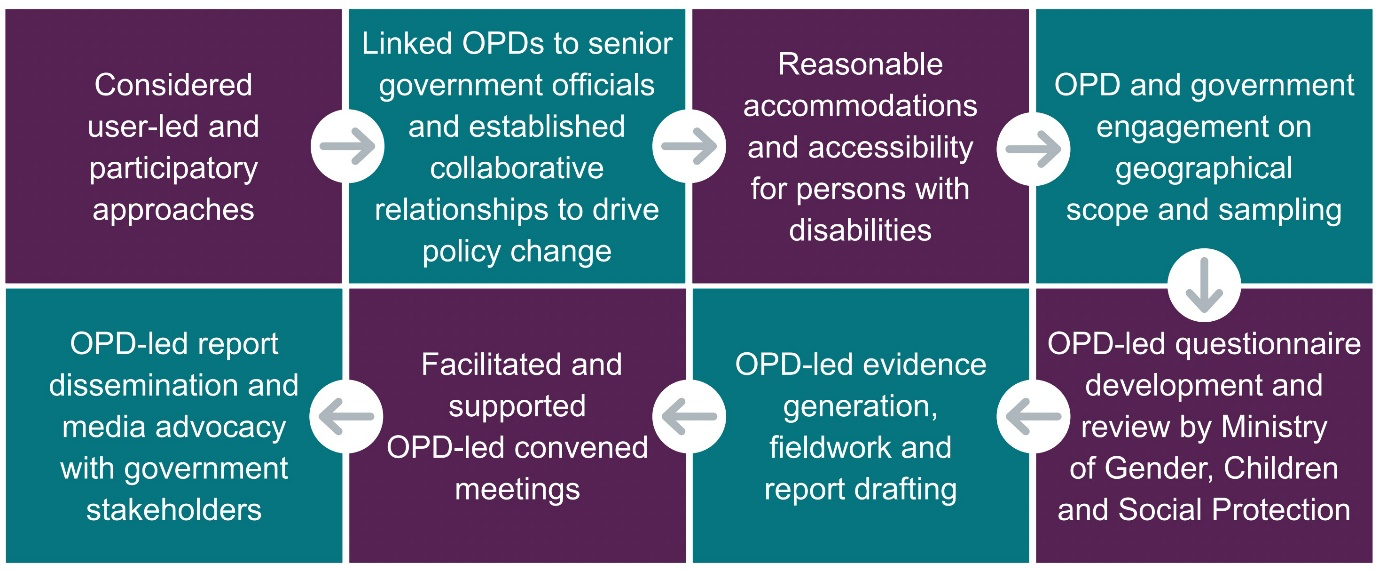
Figure 1. The stepwise user-led and inclusive approach taken to evidence gathering, each step represented in a tile, the tiles connected with arrows to indicate how steps progress.
We supported Organisations of Persons with Disabilities to engage constructively with state institutions, formulate robust advocacy messages, and build alliances across the political landscape. This enabled them to overcome challenges related to different ministerial priorities and even deflective tactics of those wishing to block the policy reform. This user-led approach to policy review secured high-level buy-in and ownership of the process from both the Organisations of Persons with Disabilities and key officials, also helping to forge relationships between ministries and civil society that have proven to be vital throughout the lifespan of the programme.
To disseminate the planned revisions, we facilitated user-led sensitization roadshows in all 16 regions of Ghana. These roadshows and follow-up meetings brought on board key regional and district officials. During 2024 the programme again visited all 16 regions in Ghana and worked with regional and district social welfare officers to secure understanding and buy-in of the revised guidelines, which were formally launched by the Minister of Gender, Children and Social Protection at the programme closing conference in September 2024. Reports from leaders of self-help groups indicate that more and more people with mental health conditions are now able to access financial support via the fund, whereas previously they had often been excluded. To quote an anonymized government official at length:
The approach adopted for the District Assembly Common Fund policy review processes has been unprecedented. It was a good thing Ghana Federation of Disability Organisations led the review process, [as] this has linked Organisations of Persons with Disabilities and people with disabilities to us senior officials at the policy level. One key thing I have learned is that it led to higher awareness on issues affecting people with disability. Hitherto, there was limited or no awareness, and most government officials have limited knowledge and did not know about their priorities. The key learning for me is big one, the rich inputs from Organisation of Persons with Disabilities, and people with disabilities themselves. This goes to reinforce the principle of nothing about us without us. My personal interaction with persons with disabilities at the working sessions, and their inputs, were useful, which has shaped my orientation and practice. The impact has been the inclusivity. (Government official 01, stakeholder interview, 2023)
Building Consensus
Lesson 3: When there are tensions or competition between stakeholders, focusing on peoples’ needs and aligning with national priorities helps to maintain relationships and ensures constructive collaboration.
It is important to note that there are often inherent ‘tensions’ between and among state and non-state actors who may be consciously or unconsciously competing against each other for resources or recognition. There will be subtle tensions and sometimes overt hostility between different government departments, as well as tensions between civil society groups. These all need to be navigated. In addressing these tensions, we built on the key learnings of the Political Economy Analysis undertaken by Ghana Somubi Dwumadie at the start of the programme to better understand how power dynamics, values, and customs and conventions affect mental health and disability policies in Ghana. We identified that stigma and discrimination against people with disabilities, including people with mental health conditions, remains very high, which typically results in politicians and other decision-makers at all levels de-prioritizing disability or mental health needs and issues. This in turn leads to increased exclusion of people with disabilities participating socially, politically, and economically in their communities.
Although legislation and policies are in place for the protection of the rights of people with disabilities, these are not being effectively realized through plans, budgets, and actions. To fill this gap, Ghana Somubi Dwumadie identified the need to place substantial emphasis on bringing evidence to bear on, and support for, the finalization of strategies, plans, and monitoring frameworks, and providing support for Organisations of Persons with Disabilities to strengthen their voice. Using evidence is key to influencing the policy environment as it helps to convince stakeholders of the need for action. Identifying opportunities and events to showcase evidence enables civil society to build awareness or strengthen links with state and service delivery actors.
We found that political leaders can sometimes favour or prioritize actions that focus on immediately visible short-term solutions, and this can be a barrier to implementing inclusive policies or driving through long-term change. However, identifying areas to unite on, such as over shared values or shared interests, can lead to opportunities to engage. Another key strategy we used was to respond very flexibly with formal and informal approaches. For example, by accepting last minute meeting invites on issues related to our areas of work (sometimes on the day itself!) in order to show engagement and willingness. We also invited relevant stakeholders to all key meetings, even if they never came. Finally, having an embedded member of staff at the Ministry of Gender, Children and Social Protection meant that we were able to take advantage of more informal connections, relationships, and ‘corridor conversations,’ in a way which was more consistent and meaningful than relying solely on formal engagements.
Lesson 4: Influencing inclusive policy development should focus on propositional approaches, building consensus on key issues identified and recommended by people with disabilities.
We recognized early on in the programme the need to take a propositional rather than oppositional approach to making change happen. In working with stakeholders who may be in opposition to our objectives, for whatever reason such as funding constraints or sensitivity to criticism, we worked to avoid actions or advocacy which could be seen to be positioned against government. This was critical for our credibility as a programme, which was providing technical assistance to government.
We moved away from advocacy models that rely heavily on media exposure, which is often generated by confrontation with or criticism of government. Instead, we focused on bringing people together and working to achieve joint successes which benefited our government stakeholders, as well as people with disabilities and mental health conditions themselves.
Within Ghana Somubi Dwumadie, which was a consortium programme, we built consensus on a collective approach to advocacy through policy dialogue for change. The consortium partners worked together as a team to ensure that each area of work was interconnected and complementary. For example, the self-help group activities ensured members were linked to key government officials within metropolitan, municipal, and district assemblies for interface meetings to deliberate on issues that affect their wellbeing, increasing informed awareness of the unmet needs and rights of people with mental health conditions.
We listened to people with mental health conditions on revising the District Assembly Common Fund guidelines and ensuring that they are clearly eligible for, and able to access, the fund. In another example, we worked closely with programme partners, stakeholders, government, and multilaterals to generate widely used evidence on the need to invest in mental health, as outlined in the case study below. To quote a government official: “the approach to consensus building between the users and those at the policy level has produced ownership by everyone” (Government official 02, stakeholder interview, 2023).
Case Study: Mental Health Investment Case
The investment case for mental health in Ghana was developed during 2020 in collaboration with the Mental Health Authority, working closely with a broad stakeholder technical working group, based on agreed priorities (Ghana Somubi Dwumadie, 2021a, 2021b, 2022a). The dissemination of the case for investment in mental health began early in 2021. The lack of sufficient financing is acknowledged to be a critical gap in mental health service provision in Ghana, and the Mental Health Authority is interested in identifying opportunities to increase the flow of funds in a sustainable way in order to support mental health. Although the case for investing in mental health has been made before, it was identified that it could be difficult to articulate compelling technical evidence to support advocacy efforts. It was proposed that the development of a well-founded investment case and advocacy tool to support and advocate for increased financing of mental health services was needed.
The approach to developing the investment case in mental health is depicted in Figure 2. Ghana Somubi Dwumadie facilitated the convening of a high-level technical working group to oversee and guide the work on the investment case with members drawn from key mental health constituencies, such as government and non-government stakeholders including Mental Health Society of Ghana, development partners, and academics, as well as people with key areas of expertise, particularly health economics and financing, evidence, advocacy, and mental health service provision and access. This helped to ensure the investment case reflected a sound knowledge base and represented a broad range of perspectives, and time was planned into the development process to allow for debate, negotiation, and reflection. In this way, the technical working group was central to developing the investment case and was an important mechanism for building consensus across government, civil society, and Organisations of People with Disabilities. The investment case was designed to be used as an advocacy tool by the Mental Health Authority and by civil society to advocate for increased funding for mental health in Ghana, by setting out the social and economic benefits of such investments. For example, the tool presented return on investment figures gleaned from academic research in a user-friendly way.
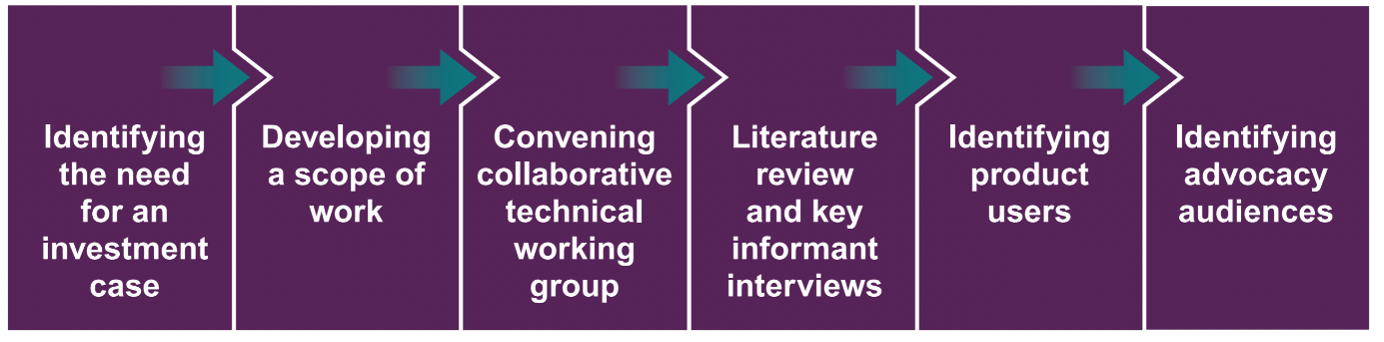
Figure 2. The approach to developing the investment case in mental health, each step represented in a tile, the tiles connected with arrows to indicate how steps progress.
At the start of 2021 the technical working group developed a dissemination plan which outlined key actions for members of the group to undertake during the year, with key roles and responsibilities identified for each. For example, the group felt that media advocacy was best led by civil society, interagency engagement was best led by Mental Health Authority, while policy advocacy would be a collaborative effort across the technical working group. Although the technical working group no longer meets, the investment case has taken on a life of its own. The investment case has been used by government staff in programme implementation districts as a tool for advocacy and health education activities, as well as a tool to engage with District Chief Executives to solicit support for mental health. It has also been extensively used by the Mental Health Authority in multiple presentations to make the case for mental health investment, including at World Mental Health Day celebrations (Sakyi et al., 2025).
Civil society organizations, including but not limited to programme grantees, have also used the investment case extensively. This includes supporting advocacy meetings with district assemblies as a mechanism to plan mental health programming, lobbying for increased investment in mental health at the community level, and informing inputs into local medium-term development plans. Key themes from the investment case were disseminated through the work of Mental Health Society of Ghana, BasicNeeds-Ghana, and the work of the Mental Health Alliance. In addition to television media appearances, some of which were facilitated by the programme and Advisory Group members, Mental Health Society of Ghana achieved a full-page front cover spread on the investment case in the Daily Graphic in October 2021 (Figure 3). Since then, a number of key asks of the investment case, such as the establishment of the Mental Health Review Tribunal and adding mental health to the National Health Insurance Scheme benefits package, have now been implemented.
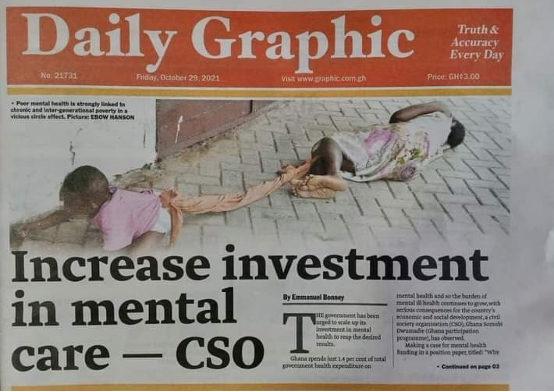
Figure 3. Front cover spread on the investment case in the Daily Graphic newspaper, October 2021. Image features two people lying on interlocked pavement. Heading reads: “Increase investment in mental care – CSO.”
Establishing Conditions for Sustainable Change
Lesson 5: Fostering a sense of ownership and stewardship supports the eventual sustainability of interventions.
We partially embedded a key member of the Ghana Somubi Dwumadie team at the Ministry of Gender, Children and Social Protection to support with coordinating and connecting the very broad range of stakeholders responsible for or engaged with disability matters, including social protection. This entailed connecting with the Sustainable Development Goals Office of the President, and the National Development Planning Commission, through the operationalization of the disability commitments outlined in the case study below.
Senior government officials of key state institutions were connected with each other and linked to work closely with the Ghana Federation of Disability Organisations to take collective ownership of disability inclusion matters, such as the District Assembly Common Fund. We supported the Ministry of Gender, Children and Social Protection and linked them up with the various sector ministries, departments, and agencies with disability and social protection oversight responsibility to work in closer collaboration with key national stakeholders, including civil society organizations, Organisations of Persons with Disabilities, and development partners. They all worked to promote the achievement of the rights of people with disabilities through access, participation, and inclusion at every level. In essence, the programme supported government to lead and take up ownership of its own mandate to work in close collaboration with people with disabilities.
Supporting government officials to roadmap and operationalize government mandates and commitments made by the Ghanian government at the Global Disability Summit built ownership of disability inclusive annual workplans and made them leaders in promoting the voices of people with disabilities in the national development framework. We moved beyond the remit of the National Council for Persons with Disability to foster ownership in their mother ministry, the Ministry of Gender, Children and Social Protection, and others involved in social protection. This generated greater institutional self-awareness, with senior government officials taking up the responsibility to lead on ensuring improved wellbeing of people with disabilities or mental health conditions.
We also provided technical assistance through Organisations of Persons with Disabilities, both directly to the Ghana Federation of Disability Organisations, and through our grants programme. The rationale was to ensure that people with disabilities became more actively involved in leading on policy engagements on matters that directly affect them. In the view of a programme manager at an Organisation of Persons with Disabilities:
Ghana Somubi Dwumadie’s approach to policy change has been a very comprehensive process and representative of the persons with disabilities themselves—in making even those at the lower level realising their needs and bringing them close to top-level senior officials to work closely to address issues. Together with Organisations of Persons with Disabilities, policymakers came up with something that is inclusive. The processes have raised high sense of policy awareness among Organisations of Persons with Disabilities making them feel they own the policy documents which has resulted in high demand for usage and implementation. (Civil society 01, stakeholder interview, 2023)
Case Study: Disability Commitments Road-Mapping
The Global Disability Summit is a mechanism for mobilizing efforts for the implementation of the United Nations Convention on the Rights of Persons with Disabilities (Global Disability Summit, 2024). It has become the driving force for engagement in generating commitments to action to help deliver Agenda 2030’s vision to ‘Leave No One Behind.’ It brings together world leaders including government officials, civil society, the private sector, the donor community, and Organisation of Persons with Disabilities to share experiences, ideas, and aspirations for inclusive development for people with disabilities. Significantly, people with disabilities design and deliver the summit, reflecting the fundamental principle of the disability rights movement: 'Nothing About Us, Without Us.’ In the first Disability Summit in 2018, and the subsequent summit in 2022, the Government of Ghana made numerous commitments to strengthen the rights and improve the wellbeing of people with disabilities. However, progress on implementing the commitments was slow. Ghana Somubi Dwumadie adopted a user-led and policy-level approach to spark accelerated implementation of all of Ghana’s commitments.
Our approach started with agreeing to the priority areas of a technical assistance plan with the Ministry of Gender, Children, and Social Protection, which included their request for support on their disability commitments. Following the second Disability Summit in 2022 which Ghana co-hosted with Norway, we worked with a range of stakeholders from the policy level, mainly senior government officials, alongside people with disabilities, to develop a concrete roadmap for the implementation, tracking, and reporting of the 22 new disability commitments made by Ghana.
Ghana Somubi Dwumadie supported people with disabilities and their representative organizations to work with the government to refine and prioritize the final disability commitments made prior to their formal submission. We brought together civil society, the National Council for Persons with Disability, the Ministry of Gender, Children and Social Protection, and the National Development Planning Commission, among others, to plan and work together with the Ghana Federation of Disability Organisations. We provided sign language interpretation, transportation, and other reasonable accommodations to facilitate meaningful participation by people with disabilities in all technical working sessions, review meetings, and validation meetings as part of the constructive engagement with policymakers and development planners at both the national and subnational levels. We worked with regional heads of the Ministry of Gender, Children and Social Protection, and the Sustainable Development Goals Office of the President to roll out the roadmap sub-nationally in Ghana.
We also strengthened the capacities of development planning officers nationwide on how to integrate, implement, monitor, and report on inclusive annual work plans. Providing assistance at different levels of the decentralized governance systems helped to mitigate and overcome previous lack of harmonization of disability work at different levels across government institutions. As of June 2024, all the 261 metropolitan, municipal, and district assemblies have developed disability inclusive workplans for implementation at the different local government levels of Ghana’s decentralized structures. According to a government official:
It was not a government only approach, civil society organisations, Organisation of Persons with Disabilities and people with disabilities themselves were involved in the roadmap for implementation. The process involved decentralised systems, National Development Planning Commission and linked them to the issues, which have been adequately captured in the national framework and in workplans of Metropolitan, Municipal, and District Assemblies. The regional and district offices whose mandate border on social protection were linked to the process which created awareness on expectations from them as contained in the commitments, in line with their roles and responsibilities. (Government official 01, stakeholder interview, 2023)
The programme also supported the Ghana Federation of Disability Organisations to coordinate monitoring of activity and commitment implementation within government institutions. In partnership with the Ministry of Gender, Children and Social Protection we supported the development of a disability reporting template for annual progress reporting by the municipal, metropolitan and district assemblies who have integrated disability inclusion actions into their workplans. We also developed an advocacy toolkit and strengthened the capacity of Organisations of Persons with Disabilities to advocate and hold government accountable (Ghana Somubi Dwumadie, 2022b). According to the Programme Manager of an Organisation of Persons with Disabilities:
In the past, persons with disabilities and did not know about the Disability Commitments made in 2018 because it remained at the policy level at the top and did not involve people with disabilities in implementation and reporting. Through the support of Ghana Somubi Dwumadie, Organisations of Persons with Disabilities have been productively involved in the 2022 Disability Commitments. Ghana Federation of Disability Organisations for instance have been engaging regional and district leadership to ensure the implementation by Metropolitan, Municipal, and District Assemblies. People with disabilities and development partners are now keen to know what is being done on tracking and monitoring to measure progress and the gaps, so they can hold government accountable. (Civil society 01, stakeholder interview, 2023)
At the time of writing this paper, the National Development Planning Commission has embraced the disability commitments and the disability inclusion framework, and has committed to adopting the disability reporting template. Working together with the National Development Planning Commission, the Ministry of Gender, Children and Social Protection, and the Ghana Federation of Disability Organisations, we supported planning officers in every region of Ghana to engage with Ghana’s disability commitments and how to implement and monitor them.
Conclusion
While acknowledging challenges along the way due to hierarchies, entrenched organizational issues, ‘unhealthy’ competitions, territorial protections, and structural and system challenges, our programme was flexible in overcoming the major barriers. To ensure we made the needed change and impact, we implemented a complementary dual approach which embedded user-led approaches into high-level policy engagements. We also ensured that wider programme activities complemented the policy goals and those of people with disabilities. For example, through extensive work on addressing stigma through social behaviour change, or by training self-help groups on rights-based advocacy approaches.
Our combined user-led and policy-level approaches created a virtuous cycle whereby we supported government to respond to the needs of people with disabilities, for example in the establishment of the Mental Health Review Tribunal. This complementary approach provided opportunities for duty holders and policymakers to recognize the issues from the perspective of people with disabilities, building an increased appreciation of policy gaps and the need to take action to embrace inclusive development. Across all the case studies outlined, and generally across the programme, we acted as connectors, creating spaces for government, multilaterals, civil society, and people with disabilities to sit and talk about disability and mental health matters. These dialogues enabled the development of informed approaches to address these issues.
Based on our experience, we recommend that programme interventions attempting to achieve policy-level change foreground the experiences and expertise of the people affected. It is essential to provide them with capacity-strengthening support so they can fully engage at the policy level. Furthermore, we advocate for supporting civil society actors in thinking politically and identifying ways to foster ownership and stewardship among policymakers and implementers. This holistic approach ensures that changes are sustainable and truly reflective of the needs of the community. We conclude with the words of one government official:
The processes have not been business as usual. Bringing National Development Planning Commission close to Organisations of Persons with Disabilities is a major boast, there is now a national sense of ownership and a national space for accountability from government by civil society organisations and persons with disability. (The Government of Ghana, 1992,Government official 02, stakeholder interview, 2023)
References
- African Union. (2018). Protocol to the African Charter on Human and Peoples’ Rights on the Rights of Persons with Disabilities in Africa. https://doi.org/10.4337/9781789903621.protocol.african.charter.disabilities
- Dapaah, E. (Adwoa), Drah, E., Sambian, J., & Adwan-Kamara, L. (2024). User-led approaches in Ghana: a reflection and response to ‘Strengthening the call to involve mental health care service users and their families in psychosocial rehabilitation programmes.’ WAPR Bulletin. World Association for Psychosocial Rehabilitation, 52(June), 1–66.
- District Assemblies Common Fund Act 455, Section 2 (1993). https://ghalii.org/akn/gh/act/1993/455/eng@1993-12-31
- French, S., & Swain, J. (2007). User involvement in services for disabled people. In R. Jones & F. Jenkins (Eds.), Key Topics in Healthcare Management: Understanding the Big Picture (1st ed.). CRC Press.
- Ghana Federation of Disability Organisations and Ghana Somubi Dwumadie. (2021). Evidence-based Review of the DACF Disability Fund Disbursement and Management Guidelines.
- Ghana Somubi Dwumadie. (2020a). Ghana Somubi Dwumadie: Summary of Political Economy Analysis.
- Ghana Somubi Dwumadie. (2020b). Improving user-led approaches in mental health and disability services. Available online at https://www.adinstitute.org/downloads/User-led-Approaches.pdf accessed 11/09/2025
- Ghana Somubi Dwumadie. (2020c). Improving user-led approaches in mental health and disability services.
- Ghana Somubi Dwumadie. (2020d). Summary of Ghana Somubi Dwumadie study on stigma and discrimination.
- Ghana Somubi Dwumadie. (2021a). Investment Case: Why Ghana needs to invest more in mental health.
- Ghana Somubi Dwumadie. (2021b). Learning Product Developing an Investment Case for Mental Health Financing. Available online at Learning-Product-Developing-an-Investment-Case.pdf accessed 11/09/2025
- Ghana Somubi Dwumadie. (2022a). Learning Product: Using an investment case for mental health (Issue January).
- Ghana Somubi Dwumadie. (2022b). Rights Based Advocacy Toolkit for Self-Help Groups.
- Ghana Statistical Service. (2014). 2010 Population and Housing Census Report: Disability in Ghana.
- Global Disability Summit. (2024). Overview and Outline for GDS 2025.
- Mwangi, G., Sakyi, L., Ae-Ngibise, K. A., Lund, C., & Weobong, B. (2023). Mental health and disability research in Ghana: a rapid review. The Pan African Medical Journal, 45, 166. https://doi.org/10.11604/pamj.2023.45.166.38808
- Roberts, M., Mogan, C., & Asare, J. B. (2014). An overview of Ghana’s mental health system: Results from an assessment using the World Health Organization’s Assessment Instrument for Mental Health Systems (WHO-AIMS). International Journal of Mental Health Systems, 8(1), 1–13. https://doi.org/10.1186/1752-4458-8-16
- Sakyi, L., Adwan-Kamara, L., Ae-Ngibise, K., & Lund, C. (2025). Acceptability and perceived impact of a mental health and disability programme in Ghana. African Journal of Disability, 14. https://doi.org/10.4102/ajod.v14i0.1659
- The Government of Ghana. (1992). The Constitution of the Republic of Ghana 1992, Chapter 020, Decentralization and Local Government. https://judicial.gov.gh/index.php/decentralization-and-local-government
- UN Division for Inclusive Social Development. (2016). Convention on the Rights of Persons with Disabilities (CRPD).
- World Bank. (2016). Ghana Social Protection Assessment and Public Expenditure Review. In Social Protection and Labor and Poverty and Equity Global Practices Africa Region. https://doi.org/10.1596/26379
- Zuurmond, M., Naami, A., Adwan-Kamara, L., Stephen, C., Basnet, S., Vanderick, C., Chantimah, M., Asamoah, A. N., Macdonald, D., & Lund, C. (2025). Stigma reduction in a disability and mental health programme in Ghana: Lessons in participation. African Journal of Disability, 14. https://doi.org/10.4102/ajod.v14i0.1508