Disrupting Ableism and Audism in Academic Accommodation Systems: A Resource List
Perturber le capacitisme et l’audisme dans les structures d’accommodement académique : une liste de ressources
Sammy Jo Johnson
PhD Candidate, Critical Disability Studies
York University
sammyjo1 [at] yorku [dot] ca
Cindu Jiang
PhD Candidate, Critical Disability Studies
York University
cindyj [at] yorku [dot] ca
Sabine Fernandes
PhD Candidate, Critical Disability Studies
York University
sabine [dot] a [dot] fermandes [at] gmail [dot] com
Heather Wong
PhD Candidate, Schulich School of Business
York University
hwong37 [at] schulich [dot] yorku [dot] ca
Kelston Cort
PhD Candidate, Faculty of Liberal Arts and Professional Studies
York University
kocort13 [at] yorku [dot] ca
Lindsay Stephens
Assistant Professor, Geography and Planning
University of Toronto
lindsay [dot] stephens [at] utoronto [dot] ca
Iris Epstein
Associate Professor, School of Nursing
York University
iepstein [at] yorku [dot] ca
Abstract
Ableism and audism are systemic in Canadian postsecondary education (PSE), perpetuating inequitable educational outcomes for disabled and deaf students. These forms of oppression are prevalent in our teaching and learning environments, as well as the academic accommodation systems expected to promote access. Despite growing scholarly attention to these challenges, it remains difficult to imagine alternative ways of conceptualizing access that move beyond the status quo. This paper addresses this challenge by exploring how access might be reimagined through practices that resist ableism and audism in higher education. Drawing on findings from a web search conducted as part of a larger environmental scan, we identify and analyze digital resources that offer new ways of understanding and practicing access within postsecondary institutions. A total of 33 digital sources were included, sorted into the following categories based on producer/user: (a) resources for institutions (n = 10); (b) resources by/for access advisors (n = 2); (c) resources by/for teachers (n = 9); and (d) resources by/for students (n = 12). Our findings highlight trends in, or alternatives to, processes of academic access. What makes these findings significant is not just that they demonstrate alternatives exist, but that they can also serve as resources for educators, administrators, and other institutional actors committed to anti-ableism/anti-audism.
Résume
Le capacitisme et l’audisme sont systémiques dans l’enseignement postsecondaire canadien, perpétuant des résultats éducatifs inéquitables pour les étudiantes et étudiants handicapés et sourds. Ces formes d’oppression sont omniprésentes dans nos environnements d’enseignement et d’apprentissage, ainsi que dans les structures d’accommodement académique censées favoriser l’accès. Malgré l’attention croissante que leur portent les travaux scientifiques, il demeure difficile d’imaginer d’autres façons de conceptualiser l’accessibilité qui dépassent le statu quo Le présent article aborde ce défi en examinant de quelles manières l’accessibilité pourrait être réimaginée au moyen de pratiques qui résistent au capacitisme et à l’audisme dans l’enseignement supérieur. À partir des résultats d’une recherche web menée dans le cadre d’une analyse environnementale plus vaste, nous identifions et analysons des ressources numériques qui proposent de nouvelles manières de comprendre et de mettre en œuvre l’accessibilité au sein des établissements postsecondaires. Au total, 33 sources numériques ont été retenues, puis classées selon leurs producteurs et leurs publics cibles dans les catégories suivantes : (a) ressources destinées aux établissements (n = 10); (b) ressources produites par/pour les conseillères et conseillers en accessibilité (n = 2); (c) ressources produites par/pour les enseignantes et enseignants (n = 9); et (d) ressources produites par/pour les étudiantes et étudiants (n = 12). Nos résultats mettent en lumière des tendances ainsi que d’autres voies possibles au sein des structures d’accommodement académique. Ce qui donne à ces résultats leur importance tient non seulement au fait qu’ils montrent que d’autres options existent, mais aussi à leur capacité à servir de ressources pour le corps professoral, les instances administratives et l’ensemble des parties prenantes engagées dans des démarches anticapacitistes et anti-audistes.
Keywords: Critical access; Disability Cultural Center; Access-centered pedagogies; Disability justice; Postsecondary education; Anti-ableism; Anti-audism
Mots-clés: Accès critique; Disability Cultural Center; pédagogies centrées sur l’accessibilité; justice pour les personnes handicapées; enseignement postsecondaire; anticapacitisme; anti audisme.
Introduction
Ableism and audism are systemic in Canadian postsecondary education (PSE), perpetuating inequitable educational experiences and outcomes for disabled and deaf students.[1] These forms of oppression are prevalent in teaching and learning environments as well as in the academic accommodation systems relied on to promote access for disabled and deaf students (Dolmage, 2017; Comeaux et al., 2021; Stapleton, 2016; Brown, 2020; Cheang, 2020; Shanouda, 2019).[2]
Academic accommodation systems often fail to create equitable learning conditions for several reasons. First, navigating accommodation processes can be taxing, draining, and financially burdensome. Second, despite the taken-for-granted notion that academic accommodations are available to all disabled students, it often takes a level of white, middle-class, linguistic and other forms of privilege to navigate these systems. Third, accommodations are specific to individual students, which means that exclusionary teaching and other institutional practices remain intact. Finally, the kinds of accommodations granted are often insufficient, providing partial and limited forms of access.
Despite growing scholarly attention to these challenges (Dhanota, 2023; Brown, 2020; Shanouda, 2019; Dolmage, 2017; Waterfield & Whalen, 2017), it remains difficult to imagine alternative ways of conceptualizing access that move beyond the status quo. This paper addresses this challenge by exploring how access might be reimagined through practices that resist ableism and audism in higher education. We situate this work within a boarder disability justice framework that defines access as a collective rather than individual responsibility.
Drawing on findings from a web search conducted as part of a larger environmental scan, we identify and analyze digital resources created and authored by instructors, students, access professionals, and advocacy organizations, as well as various postsecondary institutions. These resources, we suggest, offer new ways of understanding and practicing access within postsecondary institutions. Our goal is to highlight examples that demonstrate access as a shared responsibility that can be initiated systemically, as opposed to restrictive, highly medicalized, and individualizing approaches. In doing so, we aim to provide educators, administrators, and access professionals with tools to advance anti-ableist and anti-audist approaches to teaching, learning, and institutional policy.
The Politics of Accommodations
In PSE, disability and access are normally treated as problems to be assigned to the disability services office (DSO) (Shallish, 2015; Titchkosky & Michalko, 2012). In practice, students with disability-related access needs are directed to register with the DSO to obtain accommodations, often via a standardized statement on their course syllabi. When students connect with the DSO, decisions about disability and accessibility are informed by hegemonic practices of medicalized screening (Johnson et al., 2025). Moreover, students often have little say over the actual accommodations provided (Dolmage, 2017) and continue to experience what disability scholar Cynthia Bruce (2020) describes as precariousness: Will instructors implement accommodations consistently and promptly? Will accommodations be meaningful? Will they be enough?
Even as accessibility is siloed to one institutional office, the work of getting or achieving access is placed on the shoulders of disabled students. That is, students experiencing ableism, audism, and overlapping forms of exclusion and oppression are made individually responsible for navigating accommodation processes and expected to take on significant labour to secure access to learning (Bruce, 2020; Dolmage, 2017; Johnson et al., 2025). Students must disclose disability, clearly articulate their needs, and be prepared to self-advocate or otherwise compensate for discrimination (Karpicz, 2020). These practices are taken for granted in a university setting; how else could support needs be identified and access distributed?
Accommodation systems open doors for many students who might otherwise be shut out, including those positioned outside the imagined able-bodied, neurotypical, hearing, (English) speaking, sighted, independent, and punctual university student around whom pedagogical, extracurricular, admissions and other ordinary features of the university operate. Nonetheless, assumptions that accommodations will work narrowly in these ways ignore the racist, classist, and ableist dynamics that are also/already at work in the university. As feminist sociologist Roxana Ng (1993) reminds us, structural inequality “leaks into and becomes integral to the academy, mean[ing] that we do not participate in the academy as equals” (p. 196)—this includes its accommodation apparatus. For example, students with the least access to economic, social, and cultural capital continue to be underserved by accommodation systems and experience institutional barriers to registration, including costs of institutionally required assessments and documentation (Waterfield & Whalen, 2017).
Yet, medicalized disclosure and documentation requirements are assumed to be neutral measures on which to base decisions about access (Dhanota, 2023). Far from neutral, such mechanisms privilege those students who can more readily navigate the healthcare system without risking exposure to medical racism and cisheterosexism (Lynch, 2020; Gorman, 2013; Dhanota, 2023; Johnson et al., 2025). Investigations into institutional accommodation processes that apply a critical race perspective reveal that who is viewed as deserving of accommodations is bound up in a set of ideas about disability that are imbued with medicalized authority and saturated with whiteness (Gorman, 2013; Dhanota, 2023; Stapleton & James, 2020). Institutions claim objectivity and neutrality by insisting on a medicalized process that ignores the ways academic ableism is, for many students, shaped by racism, sexism, classism, and other oppressive systems. As a result, accepted narratives of disability—and the ways in which students are expected to tell their stories—are centered around a white, cis-male, middle-class disabled subject (Gorman, 2013). In order to be perceived as making legitimate requests of the DSO, disabled and deaf students of colour are required to fit their experiences into such a narrative, leaving out any mention of racism or sexism (Dhanota, 2023). This can be an impossible task, effectively disqualifying students whose experiences are shaped by ableism and racism, among other forms of oppression. The studies cited here work to expose the racist power dynamics that pervade the university accommodation apparatus and highlight the ways in which racism operates routinely and structurally in PSE.
Ingrained in routine accommodation procedures is another significant power disparity: students have little power to determine what they will say, how they will disclose, or make decisions about their accommodations (Dhanota, 2023; Shanouda, 2019, Dolmage, 2017; Hamraie & Khúc, 2021). Such power inequities are intensified for deaf students when working with hearing access professionals who may lack knowledge of deaf culture or the experiences of deaf, deafblind, and deafdisabled students, as well as linguistically diverse learners who use signed and spoken languages beyond American Sign Language and English (Dhanota, 2023; Arndt, 2010; García-Fernández, 2020). As a result, the quality of accommodations provided, and level of access experienced by these students, is frequently diminished.
For many disabled and deaf students, getting accommodations is not worth the amount of work required; indeed, this was something we heard in interviews that we conducted with students and other postsecondary actors following the conclusion of the web search (Fernandes et al., n.d.). This leads us to wonder about the ways in which the institutional demands imposed on students seeking accommodations, as well as the inadequacies of accommodations when granted, serve more to protect institutions from human rights complaints than to provide students with equitable and empowering postsecondary experiences (see Shallish, 2015; Dolmage, 2017; Saia, 2022; Fernandes et al., n.d.).
Theoretical Framework
Disability justice is a movement and “liberatory framework” (Kafai, 2021, p. 15) developed by disabled organizers of colour (Sins Invalid, 2019). A disability justice framework argues that a single-issue disability rights framework that treats oppression as something uniformly experienced by all disabled people “is not enough to explain the full extent of ableism and how it operates in society” (Sins Invalid, 2019, p. 16). Informed by theories of intersectionality and matrices of oppression advanced by Black feminist theorists including Kimberlé Crenshaw (1989), bell hooks (2015), and Patricia Hill Collins (2009), disability justice understands ableism as experienced differently based on intersecting power hierarchies (Sins Invalid, 2019; Mingus, 2011).
As articulated by Sins Invalid (2019), disability justice recognizes that:
- All bodies are unique and essential.
- All bodies have strengths and needs that must be met
- We are powerful, not despite the complexities of our bodies, but because of them.
- All bodies are confined by ability, race, gender, sexuality, class, nation state, religion, and more, and we cannot separate them. (Sins Invalid, 2019, p. 17).
Our theoretical lens is also informed by insights from critical access studies (Hamraie, 2017) and access-centered frameworks (Harville, 2021; Springlove, n.d.). These were particularly important as we examined how accessibility policy and practice intersect with structural inequality. They also informed our attention to examples of academic access that extend beyond dominant conceptualizations, wherein accessibility—if thought about at all—is often seen as someone else’s work, typically relegated to disabled people themselves.
Lastly, we are also informed by Ng’s (1993) discussion of anti-racist and anti-sexist work in the university—what she calls working against the grain. Ng urges educators and other institutional actors to confront the unequal power dynamics that saturate the university, which was never designed for bodies outside the privileged white, settler, cis-male, able-bodied, neurotypical, and hearing norm. Ng (1993) calls for the development of a “critical awareness of the power dynamics operating in institutional relations, and of the fact that people participate in institutions as unequal subjects” (p. 199), and she stresses the need to “rupture [the] ways university business and interactions are ‘normally’ conducted” (p. 198).
Together, these frameworks guide our analysis toward an understanding of academic accommodation as an institutional process that works unevenly and reproduces ableist and audist power imbalances in the university. Race, class, gender, immigration status and so on shape how students experience accommodation processes and even if they will engage with them (for an excellent discussion, see Dhanota, 2023). They also direct us to think of accessibility not as an individual task but something the university community is always engaged in, albeit by creating access for some bodies and not others. By integrating disability justice, critical access studies, and Ng’s (1993) call to work against the grain, we frame academic access as a collective and liberatory project that challenges the institutional reproduction of ableism and audism in higher education. It is our hope that this paper serves as a resource for readers to deepen their critical awareness of the power dynamics operating within institutional accommodation processes and to imagine new ways of practicing access in PSE.
Environmental Scan Methodology
We conducted an environmental scan, a methodology used commonly in industry to identify trends in the external environment and inform organizational changes (Lapin, 2004; Choo, 2001). Environmental scanning methodologists deploy a range of methods, including “combination[s] of literature reviews, systematic reviews, scoping reviews, web searches, questionnaires, focus groups, and interviews with key informants to uncover the range of perspectives related to a research question, topic or key term” (Ritchie et al., 2016, p. 5). We used two methods to identify alternatives in the conceptualization and practice of academic access that move beyond business-as-usual approaches and challenge existing power dynamics. First, between July and December 2022, we conducted a targeted web search focused on Canadian and US contexts. Second, between January and June 2023, we carried out key informant interviews. We report the results of our web search here.
While we have written about our search method in more detail elsewhere (Johnson et al., 2025), it is worth noting here that we did not approach the environmental scan as a neutral exercise, but rather as a situated and reflexive process. Web search activities were led by a team of disabled graduate students, and we drew from our own lived experiences with disability and (in)accessibility in the university. From this standpoint, we used the web search as a form of mapping—both noticing and charting those spaces and sites where others were moving against the status quo. We viewed these as openings for more just possibilities in academic access (Johnson et al., 2025). The resource list we present here serves less as a map, which outlines a clear path to a set destination, and more as a set of guideposts toward which we (meaning, those of us engaged in writing and reading this paper) can orient in our everyday institutional work.
Search Method
We started our search by looking at PSI websites and hoped to identify institutions outlining academic accommodation procedures that did not require students to provide medical documentation. This proved too time consuming as most websites we looked at outlined medicalized processes (i.e., the status quo). We then initiated a broader second phase using primarily Google. Keywords included disability; higher education; accommodations; (non)disclosure; (non)documentation; practicum; academic integrity; disability justice; critical access; and access-centered. We also added new search terms as we identified exciting possibilities that we wanted to explore further and included a small number of sources known to us through our work in disability studies or shared by interview participants.
Digital sources were recorded on an Excel sheet if they could be used as examples or models of alternative pathways to academic access, outside or against medicalized processes routinized in PSE that we could learn from. This was our primary inclusion criteria.
Search Results
A total of 104 digital sources were identified. To narrow this total, we applied the following exclusion criteria. First, academic sources (e.g., academic articles, book chapters) were excluded (n = 40). Second, inaccessible sources including those with inactive links or behind paywalls were excluded (n = 6). Lastly, we excluded any sources that, upon full review, did not meet our inclusion criteria (n = 25). We were left with 33 sources, as shown in Figure 1.
Figure 1. Exclusion Process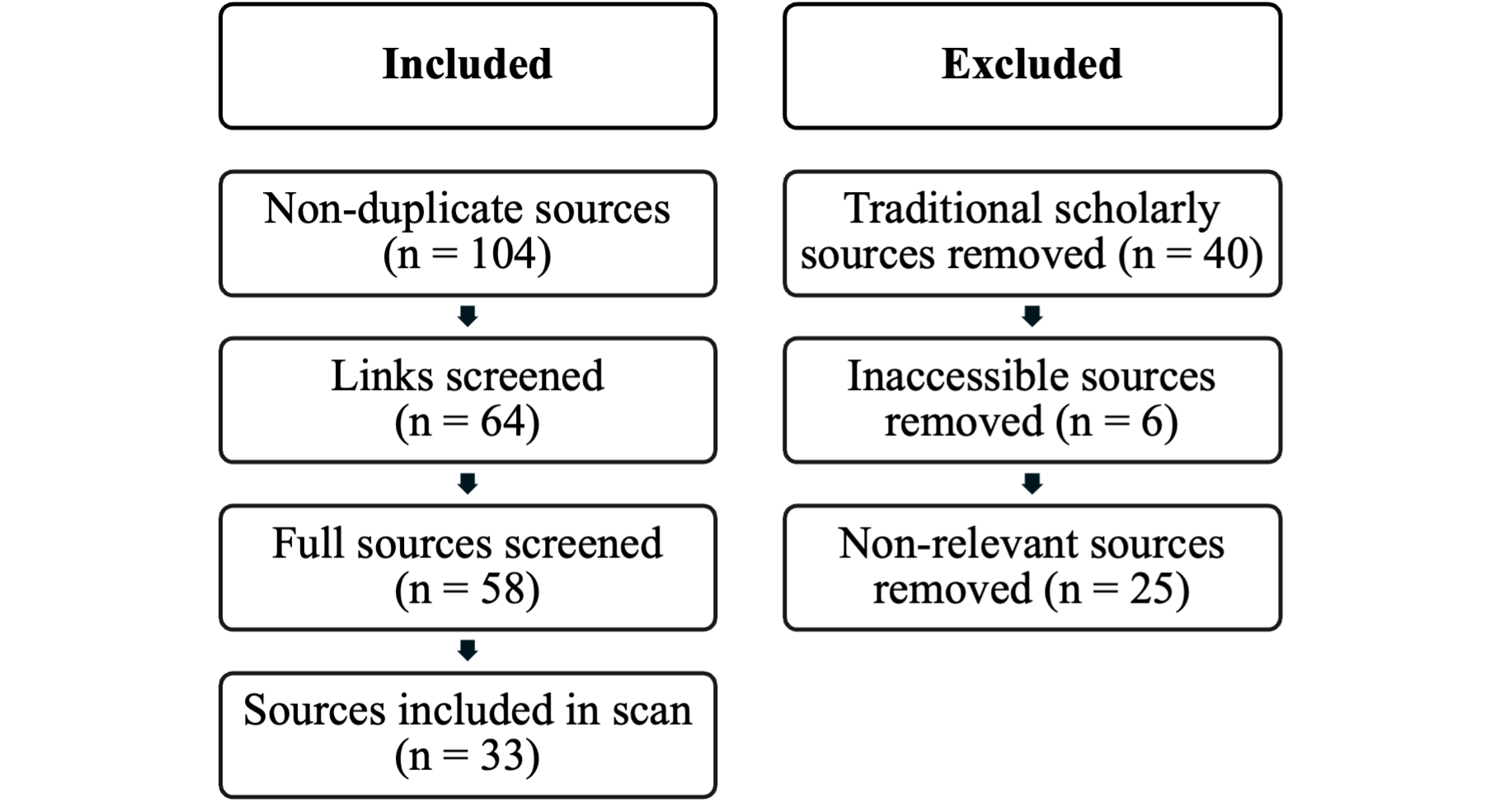
Description: The figure has wo columns with the left one titled ‘Included’ and the right one titled ‘Excluded’. Under each header are boxes summarizing the steps in the inclusion and exclusion processes, with the number of sources listed at each stage. Small arrows show that the process reduced the number of included sources from 104 to 33.
These 33 sources include websites (n = 10), webpages (n = 8), blog posts (n = 7), PDFs (n = 5), videos (n = 1), wikis (n = 1), and Google Docs (n = 1). Most originated from U.S. PSIs, organizations (e.g., student groups), or were authored by U.S.-based scholars (n = 26), with fewer by Canadian counterparts (n = 7). Excluding websites, webpages, and wikis, all other sources were published between 2017 and 2023. Analysis of websites prioritized “home” or “about us” webpages. Finally, we sorted the 33 sources into the following categories based on producer/user: (a) resources for institutions (n = 10); (b) resources by/for access advisors (n = 2); (c) resources by/for teachers (n = 9); and (d) resources by/for students (n = 12). Table 1 reports the full list.
Table 1. Resource List|
Title (hyperlinked) |
Type |
Reference |
|
Resources for institutions |
||
|
Webpage |
(Cornell University, n.d.) |
|
|
Webpage |
(Syracuse University, n.d.) |
|
|
Webpage |
(Portland State University, 2025) |
|
|
Webpage |
(The Arizona Board of Regents on behalf of The University of Arizona, 2025a) |
|
|
|
Webpage |
(UC Regents, 2025) |
|
Webpage |
(The Arizona Board of Regents on behalf of The University of Arizona, 2025b) |
|
|
Webpage |
(Board of Regents of the University of Wisconsin System, 2025) |
|
|
Website |
|
|
|
Website |
|
|
|
Website |
|
|
|
Resources for access advisors |
||
|
11. Refocus 2.0 |
Website |
|
|
12. Making Online Learning Accessible for Deaf Students: A Guide for Disability Services |
|
(National Deaf Center on Postsecondary Outcomes, 2020) |
|
Resources for instructors |
||
|
Blog post |
(Wool, 2018) |
|
|
Blog post |
(Goldrick-Rab, 2017) |
|
|
Blog post |
(Brown, 2017) |
|
|
Website |
|
|
|
17. Disability Justice & Access-Centered Pedagogy in the Pandemic |
Video |
(Hamraie & Khúc, 2021) |
|
Blog post |
(Rice-Evans, 2020) |
|
|
Blog post |
(Polish, 2017) |
|
|
Blog post |
(Hamraie, 2020) |
|
|
Wiki |
(This wiki is connected to Dolmage, 2015) |
|
|
Resources by/for students |
||
|
|
(Lynch, 2020) |
|
|
Google doc |
(Access: Student Disability Union, 2021) |
|
|
Blog post |
(Disabled Student Union, et al., 2022) |
|
|
|
(Ahmed et al., 2022) |
|
|
26. Beyond Accommodations: Accessible University Education for Disabled Students in British Columbia |
|
(Cheang, 2020) |
|
Website |
(Dhanota, 2023) |
|
|
Website |
|
|
|
Webpage |
(Duke Disability Alliance, n.d.) |
|
|
Website |
|
|
|
Website |
|
|
|
Website |
|
|
|
33. Handbook for students with disabilities: a draft/imagination for a full flipbook |
PDF (Appendix A) |
(Dhanota, 2023) |
Findings and Discussion
We have written elsewhere about the results of the larger environmental scan (Johnson et al., 2025; Fernandes et al., n.d.), summarizing web-based findings that supported the identification of emerging trends in academic access, explored more fully in key informant interviews. While those publications focus on a subset of resources (#1–4), here we analyze all 33 resources to demonstrate the range of alternatives—those practices challenging medicalized and compliance-oriented approaches to access—identified in our data.
What makes these findings significant is that they reveal shifts in taken-for-granted assumptions about access. These include shifts toward an understanding of access as a collective and abundant possibility, rather than an individual responsibility necessitating processes of strict surveillance and verification. The resources also provide practical models for educators, administrators, and students working to enact disability justice principles, anti-ableism, and anti-audism across campus contexts. Lastly, we include tips for readers on using the resource list.
Category A: Resources for Institutions
Resources #1–4, drawn from institutional DSO webpages, illustrate academic accommodation processes in which medical documentation and diagnosis play a less central role. Most of these communicate to students that their description of access needs and any barriers they experience is an important form of documentation (Johnson et al., 2025). Traditional student accommodation processes take for granted the expertise of medical professionals to determine who does and who does not qualify (Rice-Evans, 2020; Shanouda, 2019). These examples, however, suggest growing recognition of students’ lived expertise and the structural inequalities that shape who can obtain medical documentation, creating space for self-report in the documentation process (Johnson et al., 2025).
For example, Cornell University explicitly acknowledges systemic disparities in access to healthcare and commits to “working with every student to find appropriate and creative ways of ensuring access in every aspect of their Cornell experience” (Guiding Principles, n.d., para. 1). Unlike Cornell, the other institutions indicate that medical documentation may still be requested (Johnson et al., 2025), and that self-report holds varying degrees of importance. For instance, Portland State University (resource #3) only indicates to students that a diagnosis may not be required and that their experience will be considered when determining accommodations. The University of Arizona (resource #4) goes further, explicitly stating that students who do not have medical documentation are able to explore accommodations, and that student experience is central to the process.
Although these institutional examples remain partial, they reveal to us the possibility of accommodation processes that are less reliant, or at least not exclusively reliant, on medial authority. While it is important to note that claims to work with every student and accept forms of self-report articulated on institutional websites may not be realized in practice, these resources raise the possibility of alternative processes where access does not hinge so closely on practices of medical verification and checking (Johnson et al., 2025). The standard (i.e., highly medicalized) process reinforces the commonsense idea that accessibility is a scarce resource, which works to keep access at the legal minimum (Shallish, 2015; Lynch, 2020). This logic legitimizes racist, ableist, and other unequal power relations under which students face pressure to divulge personal information in sometimes traumatizing ways (Shanouda, 2019; Karpicz, 2020; Hamraie & Khúc, 2021). There is a need to co-develop alternative reporting procedures with students so that similar practices of mandated personal disclosure are not repeated under the guise of self-report (Johnson et al., 2025), and to make sure that processes change and improve on the ground and not just on institutional websites.
Resources #5–10 direct users to the websites of various Disability Cultural Centers (DCCs), all of which are based on US campuses (in fact, all 10 resources in this category direct users to postsecondary institutions in the US, which must comply with the Americans with Disabilities Act). According to Saia (2022) and Chiang (2020), DCCs present an alternative to the traditional approach to disability in the university as something shameful requiring concealment rather than part of campus diversity (see also Shallish, 2015). In contrast, these centers can provide important spaces for students to cultivate disability identity and community, from which anti-ableist action can be initiated (Saia, 2022; Elmore et al., 2018). For instance, many of the websites we engaged with describe events and activities that provide opportunities for students and the larger campus community to learn about disability culture and ableism, as well as outline commitments to improving the experiences of disabled students.
Moreover, as cultural centers, these spaces do not require students to provide documentation or disclose personal information; instead, students can come as they are, often exploring disability identity for the first time (Saia, 2022). Some students, however, may still need accommodations from the DSO to participate—for example, signing deaf students who use interpreting services within hearing-centric spaces. This raises questions not only about accessibility but also about whose knowledges and experiences are centered within campus spaces committed to facilitating change. Resultingly, while DCCs may focus on ableism, they can overlook audism.
During our search, we also found institutions using the name ‘Disability Cultural Center’ for the office responsible for determining and distributing accommodations—i.e., the DSO. Such examples were not included in our resource list. This practice of misnaming is an institutional maneuver that may function to derail student requests for an authentic cultural center, or even temporary events and activities, by claiming that such a space already exists. As this example cautions, institutional promises to challenge ableism and promote diversity can end up reinforcing the status quo. Our intent here is not to discount the importance of spaces like DCCs, but to emphasize the need to work alongside students to make them more inclusive and more effective sites for action and social justice.
User tip: If you are someone who holds institutional power and can initiate policy changes in the DSO, we suggest that resources #1–4 can serve as excellent starting places for imagining and implementing less medicalized approaches in collaboration with disabled students. Additionally, check out resources #5–10 to learn about what is going on at DCCs at other institutions and gather ideas for what one might look like on your campus.
It is important to note that although our resource list includes examples of accommodation policies and processes from US postsecondary institutions, which we suggest can be used to encourage action in Canadian institutions and the adoption of less medicalized procedures, there are barriers that make it difficult for promising policy practices and exciting examples to travel.[3] For instance, education in Canada falls under provincial and territorial jurisdiction, and “there is no clear mechanism for national policy development” (Shanahan & Jones, 2007, p. 32). On top of this, even when students do win reforms to accommodation processes in one province or territory, usually through hard-fought legal battles, they are not always implemented in others (for one example, see Dhanota, 2023). This is in part because each province and territory has its own anti-discrimination laws.
This context, however, doesn’t lessen the need for postsecondary institutions to imagine and build toward less restrictive and medicalizing futures. Rather, it makes it more important that administrators are aware of the power inequities embedded in established accommodation processes, are familiar with alternatives, and actually take steps to implement them.
Category B: Resources by/for Access Advisors
Resources #11–12 include digital toolkits intended to support access advisors in finding ways to implement proactive changes to address ableism and audism in their everyday work. Refocus 2.0 (resource #11) encourages practitioners to challenge ableism and to build access into all campus spaces and activities. Resource #12 is centered around improving the experiences of deaf postsecondary students in online classes. It provides practical tips for DSO staff and administrators to be active in initiating changes that are not isolated to individual students, such as supporting instructors in using accessible course design and creating campus policies related to captioning (National Deaf Center on Postsecondary Outcomes, 2020).
These resources provide concrete ideas for shifting campus responses to ableism and audism by reorienting the work of campus access professionals and prioritizing interventions at the classroom and institutional level. Engaging with them makes it easier to imagine an institutional approach to disability and accessibility where campus resources are committed to creating accessible spaces before students are forced to medically disclose. Under such an approach, the responsibility of ensuring accessibility is moved from individual students to the institution.
User tip: Look here if you are an access professional thinking about or already committed to working against the individualized grain of accommodations. If you are a hearing access professional and unfamiliar with deaf culture and the diverse experiences of deaf students, spend time reviewing resource #12 and discuss it with your team. This is the only deaf-centered resource on our list.
Category C: Resources by/for Instructors
Resources #13–21 outline various access-oriented pedagogies and classroom strategies by and for educators. The first four center around the practice of writing accessibility statements for course syllabi. Personally crafted accessibility statements can provide an
opening to a pedagogical practice that offers a small but powerful push against the ways college and university systems exacerbate rather than rectify social inequalities by calling out the ableism of the academy and creating an experience that is more just and accessible for all students (Wool, 2018, para. 4, emphasis in original).
Importantly, these four resources outline examples of accessibility statements that do more than simply inform students of their legal right to accommodation. The examples invite students to discuss access needs with their instructors and articulate a commitment to working collaboratively with students to meet those needs. When classroom policies include a commitment to working with students to find workable solutions to access barriers, and when instructors call out the everydayness of ableism in the academy, students may feel more empowered to share their access needs. Still, some students may have to work with the DSO to obtain accommodations—for example, due to the underrepresentation of deaf instructors, deaf students in spoken-language environments must rely on the DSO to secure interpreters. This underscores the need for change at both the level of classroom and institutional policy so that students using the DSO are not left to navigate the same-old medicalized processes.
Moving beyond the syllabus, resources #17–21 offer instructors practical ideas for building accessible experiences for and with their students. Our larger environmental scan revealed a need to enhance instructors’ skills in implementing accessible design and disability justice principles in their teaching (Fernandes et al., n.d.). These resources can help instructors do just that. For example, resources #17–18 and #20–21 provide users with clear introductions to access pedagogies and universal design for learning respectively. Resource #19 outlines a consent-based model of teaching (Polish, 2017), where students are empowered to make decisions about how they participate in class activities, recognizing that students do not experience the same levels of safety and comfort in the classroom.
These resources outline numerous strategies for building accessible experiences collaboratively with students. They also challenge taken-for-granted assumptions that access must depend on medicalized disclosure. For example, one frequently described strategy involves meeting student requests for accommodation (e.g., deadline extension, alternative formats for assignments) without requesting medical documentation or approval from the DSO. Mimi Khúc (resource #18) put it best: “I believe students when they say shit is going wrong in their life.... Because shit is going wrong with my life, of course shit is going wrong in their life, too” (Hamraie & Khúc, 2021, 19:20).
Together, these resources provide what Jay Dolmage (2015) describes as “places to actually begin changing the classroom and the syllabus” (para. 9). While there are too many to describe here, they include tips on developing accessible slides and lecture materials; strategies for collaborating with students about classroom norms; approaches to scaffolding assignments and using modelling; and ways to reimagine participation marks that do not penalize students for missing class. In addition, two of the resources (#17 and #19) are explicitly about creating accessible classrooms and virtual learning spaces in enduring pandemic times. Along with resource #12, which focuses on creating accessible online spaces for and with deaf students, these provide places for educators to begin imagining and, hopefully, implementing access pedagogies in virtual classrooms and hybrid learning spaces, which are not automatically accessible to all students.
User tip: Look here for tips and strategies on accessible teaching you can implement in your classroom regardless of your experience with access-centered teaching and without waiting for students to medically authorize their access requests. As you implement new practices in your classes, remember that students have many different access needs, and these may fluctuate. Be sure to check in with students about what is and isn’t working for them and be open to trying out new strategies.
Category D: Resources by/for Students
Of all four categories, these student-authored resources present the most radical vision for academic access. Importantly, they make apparent that academic access requires a widespread transformation to campus culture and business as usual in the university.
The first five resources (#22–26) include materials created by disabled student organizers and allies as part of specific campus movements against ableism and other forms of educational injustice, as well as student-authored policy recommendations. In the UC Access Now Demandifesto (resource #22), disabled student Megan Lynch (2020) outlines demands for a campus-wide approach to academic access in response to the University of California’s reliance on a compliance-oriented approach. While there is too little space here to do justice to these demands, even a summary reveals a radically different understanding of access that lies at the heart of the Demandifesto. The student-led demands include: greater representation of disabled students, instructors, and staff, especially those who are multiply marginalized; anti-ableism training for instructors and staff; the incorporation of critical disability perspectives in all programs to ensure graduates are equipped to challenge disability oppression in their future careers; accessible and affordable campus housing; and anti-ableist/anti-racist admissions policies (Lynch, 2020).
Across these resources, students also call for less medicalized approaches to accommodations that privilege students own account of what they need as an essential anti-ableist, anti-racist, and anti-classist strategy (Ahmed et al., 2022; Access: Student Disability Union, 2021; Disabled Student Union et al., 2022). Resource #24, authored by the Disabled Student Union, the Mother Organizations Coalition, and the Undergraduate Students Association Council at UCLA, highlights the urgency of these demands. In this document, written two years into the COVID-19 pandemic, student organizers call on UCLA administrators to implement hybrid learning options for all UCLA students and instructors. Having witnessed the move to remote learning the year prior, the authors reject the individualized and piecemeal approach to accommodations—where only students who medically qualify can receive accommodated hybrid learning options—as one that puts marginalized students and members of the campus community at risk. The authors also reject the university’s claim that hybrid options would be too costly, arguing that “time and financial constraints disappear…when our non-disabled peers are impacted” (Disabled Student Union et al., 2022, para. 2). Here student organizers insist that individual accommodations are not enough, they do not keep all students safe, and that access can be implemented more systemically because it already has been.
Resources #27–32 include the websites or webpages of various disabled student groups in both Canada and the US. These seem to do much of the same work as DCCs, though likely with less institutional resources. For example, Students for Barrier-Free Access (SBA) at the University of Toronto (resource #27) offers a space for connection, community, and collective learning about disability justice. The SBA is also committed to campus advocacy on behalf of disabled and deaf students and community members. The final resource (#33) directs users to a digital guide to academic accommodations by and for students of colour. Websites for some of the student groups included in our list also provide practical supports, including guides to navigating accommodation processes. By outlining tips and tactics developed by students for students, these digital resources challenge the dominant approach to accessibility that is based on a logic of scarcity and requires students to undertake significant forms of labour to meet institutional disclosure and verification demands. Reading them, we can’t help but ask: why does it have to be so hard? In this way, these resources point toward an alternative approach—one that is supportive rather than restrictive.
User tip: For students, look here to learn about what student organizers are doing to call for systemic responses to ableism. You’ll also find practical insights from peers on navigating accommodation processes that are intentionally difficult to traverse. For administrators and instructors, check out these resources if you are unsure what a systemic commitment to academic access might entail, and to read about the pedagogical practices that students themselves identify as key to creating more equitable learning experiences.
Conclusion
This study is limited by its reliance on web-based data, which identifies emerging trends but does not capture lived experiences. Further research could examine how these alternative practices unfold in context and how students experience self-reporting, cultural centers, and disability-focused student groups in practice. Nevertheless, our discussion points toward a critical reimagining of access and alternative possibilities that do not hinge on medical eligibility and are grounded in co-creation with disabled students. Moreover, we suggest that these resources, when read together, can help to challenge assumptions about scarcity that underpin traditional accommodation systems and invite educators and institutions to rethink access and build it expansively. We urge readers to engage with these resources to find concrete strategies to practice access against the grain wherever they are situated institutionally and in ways that leave no one behind.
Endnotes
1. Deaf scholar Tom Humphries first used the term “audism” 50 years ago; nevertheless, it remains undertheorized within critical disability scholarship. In this paper we draw from Bauman’s (2004) discussion of systemic audism as a power relation that is based on assumptions of hearing superiority, and which saturates institutional structures like the university in ways that maintain hearing privilege and disprivilege deaf students, instructors, etc.2. Some deaf students may identify as part of a linguistic and cultural minority, often indicated in writing by using the upper case Deaf, and some may not (yet). In this paper, we use the lowercase deaf in an inclusive way, to recognize these as well as other experiences (e.g., hard of hearing, deafblind, deafdisabled), in a manner similar to the National Deaf Center on Postsecondary Outcomes (2025).
3. We thank the anonymous reviewer who brought this point to our attention.
References
- Access: Student Disability Union. (2021, April 6). The access advocacy project. https://docs.google.com/document/d/1AgXex87nJpegxRU7GQVRjcmpksRNhINbNo2E1iPBB44/edit?pli=1
- Ahmed, E., Ali, S., Belik, C., Bueneman, L., Collins, C., Cryderman, E., Dirie, A., Egan, L., Gerrits, E., Graham, R., Harlan, S., Hnatiw, C., Kelly, E., Ladouceur, J., Minty, H., Oladele, D., Pazmino, D., Strowbridge, S., Warne, E., & Zubac, A. (2022). Maddening Carleton: A mental health framework (pp. 1–35). https://drive.google.com/file/d/1ujVmNYPCKQFjGW7fBd3FJ_2QyxHqADFX/view?pli=1
- The Board of Trustees of the University of Illinois. (2025). Disability cultural center. https://dcc.uic.edu
- The Arizona Board of Regents on behalf of The University of Arizona. (2025a). Connect with DRC. Disability Resource Center https://drc.arizona.edu/students/connect-drc
- The Arizona Board of Regents on behalf of The University of Arizona. (2025b). Omnes Disability Student Space. Campus Community Connections. https://ccc.arizona.edu/student-spaces/student-culture-and-engagement-hub/omnes-disability-student-space
- Arndt, K. (2010). College students who are deafblind: Perceptions of adjustment and academic supports. AER Journal: Research and Practice in Visual Impairment and Blindness, 3(1), 12–19.
- Bauman, H.-D. L. (2004). Audism: Exploring the metaphysics of oppression. Journal of Deaf Studies and Deaf Education, 9(2), 239–246. https://doi.org/10.1093/deafed/enh025
- Board of Regents of the University of Wisconsin System. (2024). Disability culture center (DCC). McBurney Disability Resource Center. https://mcburney.wisc.edu/dcc/
- Brown, L. X. Z. (2017). Syllabus language. Autistic Hoya. https://autistichoya.net/resources/syllabus-language/
- Brown, Z. (2020). Ableism, intersectionality, power and knowledge: The complexities of navigating accommodations in postsecondary institutions [MRP, York University]. YorkSpace.https://yorkspace.library.yorku.ca/xmlui/bitstream/handle/10315/37846/CDS%20MRP%20Final%20October%2027%202020.%20Zahra%20Brown.pdf?sequence=1&isAllowed=y
- Bruce, C. (2020). Self-advocacy as precariousness in university education. Canadian Journal of Disability Studies, 9(5), 414–440. https://doi.org/10.15353/cjds.v9i5.703
- Cheang, R. (2020). Beyond accommodations: Accessible university education for disabled students in British Columbia [Policy brief]. LEVEL Youth Policy Program. https://levelvf.ca/wp-content/uploads/2020/09/Rachel_SINGLE-PAGES.pdf
- Chiang, E. S. (2020). Disability cultural centers: How colleges can move beyond access to inclusion. Disability & Society, 35(7), 1183–1188. https://doi.org/10.1080/09687599.2019.1679536
- Choo, C.W. (2001). Environmental scanning as information seeking and organizational learning. Information Research, 7(1). https://www.informationr.net/ir/7-1/paper112.html
- Comeaux, E., Mireles, D., & Acha, A. (2021). Dis/abled student campusmaking: Sites of new possibility. Education Sciences, 11(11), 745. https://doi.org/10.3390/educsci11110745
- Cornell University. (n.d.). Guiding principles. Student Disability Services. https://sds.cornell.edu/about/guiding-principles
- Crenshaw, K. (1989). Demarginalizing the intersection of race and sex: A Black feminist critique of antidiscrimination doctrine, feminist theory and antiracist politics. University of Chicago Legal Forum, 1989(1), 139–167. https://chicagounbound.uchicago.edu/uclf/vol1989/iss1/8
- Dhanota, N. (2023). Transgressing institutional limits to access in post-secondary disability service offices: A critical race theory and BIPOC mad studies framework [Doctoral dissertation, York University]. YorkSpace. http://hdl.handle.net/10315/41065
- Our Space and Mission. (n.d.). Disability cultural center at UNCA. https://disabilityculturalcenter.wp.unca.edu
- Disabled Student Union, Mother Organizations Coalition, and Undergraduate Students Association Council. (2022, February 6). Hybrid access now: Statement by UCLA student coalitions. Disability Visibility Project. https://disabilityvisibilityproject.com/2022/02/06/hybrid-access-now-statement-by-ucla-student-coalitions/
- Dolmage, J. (2017). Academic ableism: Disability and higher education. University of Michigan Press.
- Dolmage, J. (2015). Universal design: Places to start. Disability Studies Quarterly, 35(2). https://doi.org/10.18061/dsq.v35i2.4632
- Duke Disability Alliance. (n.d.). https://sites.duke.edu/disabilityatduke/dda/
- Elmore, K., Saia, T., & Thomson, E. A. (2018). Special feature: An introduction to disability cultural centers in U.S. higher education, Part I - AHEAD - Association on Higher Education And Disability. https://www.ahead.org/professional-resources/publications/hub/hub-nov-2018/hub-nov-2018-special-feature-disability-cultural-centers
- Fernandes, S., Johnson, SJ., Wong, H., Jiang, C., Cort, K., Stephens, I., & Epstein I. (n.d.). Transforming Academic Access: Findings and Recommendations from the CIPA Project. Pressbooks. https://ecampusontario.pressbooks.pub/cipa/
- García-Fernández, C. (2020). Intersectionality and autoethnography: DeafBlind, DeafDisabled, Deaf and Hard of Hearing-Latinx Children are the future. JCSCORE, 6(1), 40–67. https://doi.org/10.15763/issn.2642-2387.2020.6.1.40-67
- Goldrick-Rab, S. (2017, August 7). Basic needs security and the syllabus. Medium. https://saragoldrickrab.medium.com/basic-needs-security-and-the-syllabus-d24cc7afe8c9
- Gorman, R. (2013). Mad nation? Thinking through race, class, and mad identity politics. In B.A. LeFrançois, R. Menzies, G. Reaume (Eds.), Mad matters: A critical reader in Canadian mad studies (pp. 269-280). Canadian Scholars.
- Hamraie, A. (2017). Building access: Universal design and the politics of disability. University of Minnesota Press.
- Hamraie, A. (2020, March 10). Accessible teaching in the time of COVID-19. Critical Design Lab. https://www.mapping-access.com/blog-1/2020/3/10/accessible-teaching-in-the-time-of-covid-19
- Hamraie, A., & Khúc, M. (2021, February 28). Disability justice & access-centered pedagogy in the pandemic [Webinar]. Autistic Women & Nonbinary Network. https://awnnetwork.org/webinars/disability-justice-access-centered-pedagogy-in-the-pandemic/
- Harville, I. (2021, November 1). Move your body: Access-centered movement is changing dance from the inside out. Bitch Media.
- Hill Collins, P. (2009). Black feminist thought: Knowledge, consciousness, and the politics of empowerment (2nd ed.). Routledge.
- hooks, bell. (2015). Feminist theory: From margin to center. Routledge.
- Johnson, SJ., Jiang, C., Fernandes, S., Wong, H., Cort, K., Stephens, I., & Epstein I. (2025) “Do you want to start a revolution?”: Environmental Scanning for Alternatives to Academic Accommodations [Manuscript submitted for publication].
- Kafai, S. (2021). Crip kinship: The disability justice & art activism of Sins Invalid. Arsenal Pulp Press.
- Karpicz, J. R. (2020). “Just my being here is self-advocacy”: Exploring the self-advocacy experiences of disabled graduate students of color. JCSCORE, 6(1), 137–163. https://doi.org/10.15763/issn.2642-2387.2020.6.1.137-163
- Lapin, J. (2004). Using external environmental scanning and forecasting to improve strategic planning. Journal of Applied Research in the Community College, 11(2), 105–113.
- Lynch, M. (2020). UC access now demandifesto (pp. 1–21). UC Access Now; Internet Archive. https://archive.org/details/disability-equity-and-justice-demands/mode/2up
- Mingus, M. (2011, February 12). Changing the framework: Disability justice. Leaving Evidence. https://leavingevidence.wordpress.com/2011/02/12/changing-the-framework-disability-justice/
- National Deaf Center on Postsecondary Outcomes. (2020). Making online learning accessible for deaf students: A guide for disability services (pp. 1–11). https://nationaldeafcenter.org/wp-content/uploads/2020/07/DSP_OnlineClassAccessibility-WEB.pdf
- National Deaf Center on Postsecondary Outcomes. (2025). Deaf awareness. https://nationaldeafcenter.org/resources/deaf-awareness/#definingdeaf
- Ng, R. (1993). “A woman out of control”: Deconstructing sexism and racism in the university. Canadian Journal of Education / Revue Canadienne de l’éducation, 18(3), 189–205. https://doi.org/10.2307/1495382
- Polish, J. (2017, October 12). Consent-based pedagogy and “low stakes” assignments. (De)Composing Dis/Ability. https://decomposing.commons.gc.cuny.edu
- Portland State University. (2024). Information for students. Disability Resource Center. https://www.pdx.edu/disability-resource-center/information-students
- Rice-Evans, J. (2020, November 13). Open access pedagogy: A manifesto. Anti-Ableist Composition. https://antiableistcomposition.wordpress.com/2020/11/13/open-access-pedagogy-a-manifesto/
- Ritchie, S. D., Patrick, K., Corbould, G. M., Harper, N. J., & Oddson, B. E. (2016). An environmental scan of adventure therapy in Canada. Journal of Experiential Education, 39(3), 303–320. https://doi.org/10.1177/1053825916655443
- Saia, T. (2022). Disability cultural centers in higher education: A Shift beyond compliance to disability culture and disability identity. Journal of Postsecondary Education & Disability, 35(1), 17-30.
- Shallish, L. (2015). “Just how much diversity will the law permit?”: The Americans with Disabilities Act, diversity and disability in higher education. Disability Studies Quarterly, 35(3). https://doi.org/10.18061/dsq.v35i3.4942
- Shanahan, T., & Jones, G. A. (2007). Shifting roles and approaches: Government coordination of post‐secondary education in Canada, 1995–2006. Higher Education Research & Development, 26(1), 31- 43. https://doi.org/10.1080/07294360601166794
- Shanouda, F. (2019). The violent consequences of disclosure … and how disabled and mad students are pushing back. In B. Whitburn & C. McMaster (Eds.), Disability and the university: A disabled students’ manifesto. Peter Lang.
- Sins Invalid. (2019). Skin, tooth, and bone: The basis of movement is our people (2nd ed.).
- Springlove. (n.d.). Why access-centered movement? Access-Centered Movement. https://accesscenteredmovement.com/2017/07/05/why/
- Stapleton, L. (2016). Audism and racism: The hidden curriculum impacting Black d/Deaf college students in the classroom. Negro Educational Review, 67(1–4), 149–168.
- Stapleton, L., & James, L. (2020). Not another all white study: Challenging color-evasiveness ideology in disability scholarship (Practice Brief). Journal of Postsecondary Education and Disability, 33(3), 215–222. https://files.eric.ed.gov/fulltext/EJ1281055.pdf
- Syracuse University. (n.d.). Documentation guidelines. Center for Disability Resources. https://disabilityresources.syr.edu/about/documentation/
- Titchkosky, T., & Michalko, R. (2012). The body as the problem of individuality: A phenomenological disability studies approach. In D. Goodley, B. Hughes, & L. Davis (Eds.), Disability and Social Theory (pp. 127–142). Palgrave Macmillan UK. https://doi.org/10.1057/9781137023001_8
- UC Regents. (2024). Who we are. Berkeley Disabled Students’ Program. https://dsp.berkeley.edu/who-we-are-dcc-1
- Waterfield, B., & Whelan, E. (2017). Learning disabled students and access to accommodations: socioeconomic status, capital, and stigma. Disability & Society, 32(7), 986–1006. https://doi.org/10.1080/09687599.2017.1331838
- Wool, Z. (2018, August 13). Check your syllabus 101: Disability access statements. ANTHRO{DENDUM}. https://anthrodendum.org/2018/08/13/check-your-syllabus-101-disability-access-statements/